






 9HAD
9HAD
Der f 21 dust mite allergen with computationally designed DerF21_b10 binder
Summary for 9HAD
| Entry DOI | 10.2210/pdb9had/pdb |
| Descriptor | Mite allergen Der f 21.0101, DerF21_binder10 (3 entities in total) |
| Functional Keywords | dust mite, allergen, der f 21, computational, de novo, binder, de novo protein |
| Biological source | Dermatophagoides farinae (American house dust mite) More |
| Total number of polymer chains | 4 |
| Total formula weight | 57562.01 |
| Authors | Pacesa, M.,Nickel, L.,Correia, B.E. (deposition date: 2024-11-03, release date: 2024-12-18, Last modification date: 2025-10-22) |
| Primary citation | Pacesa, M.,Nickel, L.,Schellhaas, C.,Schmidt, J.,Pyatova, E.,Kissling, L.,Barendse, P.,Choudhury, J.,Kapoor, S.,Alcaraz-Serna, A.,Cho, Y.,Ghamary, K.H.,Vinue, L.,Yachnin, B.J.,Wollacott, A.M.,Buckley, S.,Westphal, A.H.,Lindhoud, S.,Georgeon, S.,Goverde, C.A.,Hatzopoulos, G.N.,Gonczy, P.,Muller, Y.D.,Schwank, G.,Swarts, D.C.,Vecchio, A.J.,Schneider, B.L.,Ovchinnikov, S.,Correia, B.E. One-shot design of functional protein binders with BindCraft. Nature, 646:483-492, 2025 Cited by PubMed Abstract: Protein-protein interactions are at the core of all key biological processes. However, the complexity of the structural features that determine protein-protein interactions makes their design challenging. Here we present BindCraft, an open-source and automated pipeline for de novo protein binder design with experimental success rates of 10-100%. BindCraft leverages the weights of AlphaFold2 (ref. ) to generate binders with nanomolar affinity without the need for high-throughput screening or experimental optimization, even in the absence of known binding sites. We successfully designed binders against a diverse set of challenging targets, including cell-surface receptors, common allergens, de novo designed proteins and multi-domain nucleases, such as CRISPR-Cas9. We showcase the functional and therapeutic potential of designed binders by reducing IgE binding to birch allergen in patient-derived samples, modulating Cas9 gene editing activity and reducing the cytotoxicity of a foodborne bacterial enterotoxin. Last, we use cell-surface-receptor-specific binders to redirect adeno-associated virus capsids for targeted gene delivery. This work represents a significant advancement towards a 'one design-one binder' approach in computational design, with immense potential in therapeutics, diagnostics and biotechnology. PubMed: 40866699DOI: 10.1038/s41586-025-09429-6 PDB entries with the same primary citation |
| Experimental method | X-RAY DIFFRACTION (2.75 Å) |
Structure validation
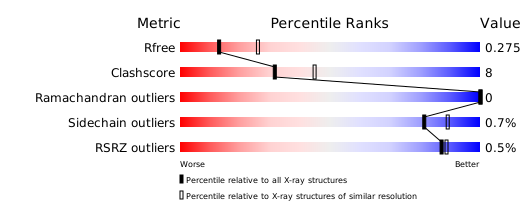
Download full validation report


