






 9H66
9H66
Steroidal Selective Modulators of FXR with Therapeutic Potential
Summary for 9H66
| Entry DOI | 10.2210/pdb9h66/pdb |
| Descriptor | Bile acid receptor, Nuclear receptor coactivator 2, (4~{R})-4-[(3~{R},4~{R},5~{S},6~{R},7~{R},8~{S},9~{S},10~{R},13~{R},14~{R},17~{R})-6-ethyl-4-fluoranyl-10,13-dimethyl-3,7-bis(oxidanyl)-2,3,4,5,6,7,8,9,11,12,14,15,16,17-tetradecahydro-1~{H}-cyclopenta[a]phenanthren-17-yl]-~{N}-[4-(trifluoromethyloxy)phenyl]sulfonyl-pentanamide, ... (4 entities in total) |
| Functional Keywords | nuclear receptor, ligand binding domain, complex, nuclear protein |
| Biological source | Homo sapiens (human) More |
| Total number of polymer chains | 10 |
| Total formula weight | 120610.98 |
| Authors | Kydd-Sinclair, D.,Watson, K.A. (deposition date: 2024-10-23, release date: 2025-09-10, Last modification date: 2025-09-17) |
| Primary citation | Kydd-Sinclair, D.,Packer, G.L.,Weymouth-Wilson, A.C.,Watson, K.A. Structural Basis of Novel Bile Acid-Based Modulators of FXR. J.Mol.Biol., 437:169383-169383, 2025 Cited by PubMed Abstract: Following its deorphanisation in the early 2000s, the farnesoid X receptor (FXR) attracted significant attention for regulating genes involved in bile acid, lipid and glucose metabolism and inflammation, pathways central to many liver diseases. As such, pharmaceutical efforts targeted FXR for their treatment. However, while FXR agonists, such as obeticholic acid, have been studied in clinical trials, many were associated with adverse effects arising from the promiscuity of systemic FXR activation, thus efforts to limit or selectively modulate the downstream effects of FXR are crucially important. In work here, two novel bile acid derivatives, previously identified via molecular docking and cell-based screening, were validated by X-ray crystallography and tested in LanthaScreen coactivator recruitment assays. Their effects on downstream FXR signalling were assessed in vitro in hepatocellular carcinoma cells, and in vivo in C57BL/6 mice, by RNA sequencing and RT-qPCR. The novel compounds exhibited potent and selective FXR agonist activity. Co-crystal structures of FXR LBD with both compounds, demonstrated distinctive binding modes for each, including occupancy of a receptor sub-pocket associated with allosteric activation, not observed with classic bile acids. Both compounds were up to four-fold more potent than obeticholic acid and demonstrated ligand-dependent differences in coactivator recruitment assays. In vitro, both compounds induced greater changes in the expression of FXR target genes, at lower doses than obeticholic acid. In vivo, compound-dependent differential gene expression was observed. These findings suggest that the novel compounds may enable gene-specific FXR regulation through differential coactivator usage and hold potential to overcome the shortcomings of current bile acid drugs, thus representing promising candidates for further research. PubMed: 40803552DOI: 10.1016/j.jmb.2025.169383 PDB entries with the same primary citation |
| Experimental method | X-RAY DIFFRACTION (2.6 Å) |
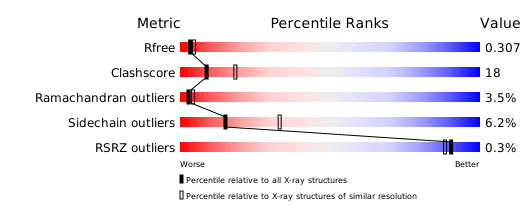
Structure validation
Download full validation report


