






 9GY5
9GY5
Crystal structure of the catalytic domain from the BoNT-like toxin complex PG1 of Paeniclostridium ghonii
Summary for 9GY5
| Entry DOI | 10.2210/pdb9gy5/pdb |
| Descriptor | Catalytic domain from the BoNT-like toxin complex PG1 of Paeniclostridium ghonii, ZINC ION, SULFATE ION, ... (6 entities in total) |
| Functional Keywords | neurotoxin, metalloprotease, toxin |
| Biological source | Paraclostridium ghonii |
| Total number of polymer chains | 1 |
| Total formula weight | 45290.84 |
| Authors | Masuyer, G.,Stenmark, P. (deposition date: 2024-10-01, release date: 2025-10-15, Last modification date: 2025-11-26) |
| Primary citation | Lee, P.G.,Yin, L.,Wei, X.,Shi, J.,Masuyer, G.,Wentz, T.G.,Chen, P.,Xu, Y.,Liang, J.,Zhang, H.,Persson Kosenina, S.,Lobb, B.,Mansfield, M.,Gill, S.S.,Pellett, S.,Stenmark, P.,Doxey, A.C.,Dong, M. Identification and characterization of botulinum neurotoxin-like two-component toxins in Paeniclostridium ghonii. Sci Adv, 11:eadx6145-eadx6145, 2025 Cited by PubMed Abstract: Insecticidal bacterial proteins play key roles in insect-bacteria interactions and have been used as biopesticides. Here, we identify two insecticidal proteins in , designated PG-toxin 1 (PG1) and PG-toxin 2 (PG2), which are homologs of botulinum neurotoxins (BoNTs). Unlike BoNTs, PG1 and PG2 contain two separate proteins: One is the protease light chain (LC), and the other is the heavy chain containing the translocation domain and the receptor binding domain. Crystal and cryo-electron microscopy structures show a conserved BoNT-like architecture but without an interchain disulfide bond. Functional characterizations establish that the LCs of PG1 and PG2 cleave insect synaptosomal-associated protein 25 (SNAP25), but not human or rat SNAP25, and microinjection of PG1 and PG2 caused paralysis and death in and mosquitoes. These findings identified unique two-component BoNT-like insecticidal proteins, revealing insights into the evolution of the BoNT family of toxins, and broadening our understanding of bacteria that can be used for biopest controls. PubMed: 41223264DOI: 10.1126/sciadv.adx6145 PDB entries with the same primary citation |
| Experimental method | X-RAY DIFFRACTION (1.8 Å) |
Structure validation
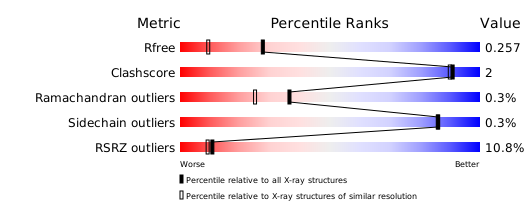
Download full validation report


