






 9GV4
9GV4
TBA G-quadruplex binding nanobody (free form)
Summary for 9GV4
| Entry DOI | 10.2210/pdb9gv4/pdb |
| Descriptor | Nanobody, 1,2-ETHANEDIOL, SULFATE ION, ... (5 entities in total) |
| Functional Keywords | nanobody, g-quadruplex, tba, thrombin, dna, immune system |
| Biological source | Lama glama |
| Total number of polymer chains | 1 |
| Total formula weight | 14151.47 |
| Authors | |
| Primary citation | Pevec, M.,Medved, T.,Kovacic, M.,Zerjav, N.,Imperl, J.,Plavec, J.,Lah, J.,Loris, R.,Hadzi, S. Structural basis of G-quadruplex recognition by a camelid antibody fragment. Nucleic Acids Res., 53:-, 2025 Cited by PubMed Abstract: Apart from the iconic Watson-Crick duplex, DNA can fold into different noncanonical structures, of which the most studied are G-quadruplexes (G4s). Despite mounting structural and biophysical evidence, their existence in cells was controversial until their detection using G4-specific antibodies. However, it remains unknown how antibodies recognize G4s at the molecular level and why G4-specific antibodies have low selectivity and are unable to distinguish different G4 sequences. Here, we present the crystal structure of a nanobody bound to the archetypical G4 structure, the thrombin-binding aptamer (TBA). The nanobody exhibits strong selectivity against different G4 sequences and utilizes an unusual scaffold-based paratope, with very limited involvement of complementarity-determining region. The nanobody effectively mimics the binding interface of thrombin, a natural binding partner of TBA, by using isosteric interactions at key positions. The presented structure sheds light on the molecular basis of how antibodies, essential G4-detection tools, recognize noncanonical G4 structures. PubMed: 40433978DOI: 10.1093/nar/gkaf453 PDB entries with the same primary citation |
| Experimental method | X-RAY DIFFRACTION (1.534 Å) |
Structure validation
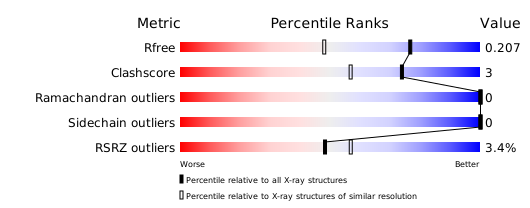
Download full validation report


