






 9GSL
9GSL
Cryo-EM structure of human SLC35B1 in inward facing conformation
Summary for 9GSL
| Entry DOI | 10.2210/pdb9gsl/pdb |
| Related | 9GRY 9GRZ 9GS3 9GS5 9GS7 |
| EMDB information | 51551 |
| Descriptor | Solute carrier family 35 member B1, Fv-MBP (2 entities in total) |
| Functional Keywords | atp:adp exchanger, axer, amp-pnp, membrane protein, transport protein |
| Biological source | Homo sapiens (human) More |
| Total number of polymer chains | 2 |
| Total formula weight | 104320.04 |
| Authors | Gulati, A.,Ahn, D.,Suades, A.,Drew, D. (deposition date: 2024-09-16, release date: 2025-05-21, Last modification date: 2025-08-20) |
| Primary citation | Gulati, A.,Ahn, D.H.,Suades, A.,Hult, Y.,Wolf, G.,Iwata, S.,Superti-Furga, G.,Nomura, N.,Drew, D. Stepwise ATP translocation into the endoplasmic reticulum by human SLC35B1. Nature, 643:855-864, 2025 Cited by PubMed Abstract: ATP generated in the mitochondria is exported by an ADP/ATP carrier of the SLC25 family. The endoplasmic reticulum (ER) cannot synthesize ATP but must import cytoplasmic ATP to energize protein folding, quality control and trafficking. It was recently proposed that a member of the nucleotide sugar transporter family, termed SLC35B1 (also known as AXER), is not a nucleotide sugar transporter but a long-sought-after ER importer of ATP. Here we report that human SLC35B1 does not bind nucleotide sugars but indeed executes strict ATP/ADP exchange with uptake kinetics consistent with the import of ATP into crude ER microsomes. A CRISPR-Cas9 cell-line knockout demonstrated that SLC35B1 clusters with the most essential SLC transporters for cell growth, consistent with its proposed physiological function. We have further determined seven cryogenic electron microscopy structures of human SLC35B1 in complex with an Fv fragment and either bound to an ATP analogue or ADP in all major conformations of the transport cycle. We observed that nucleotides were vertically repositioned up to approximately 6.5 Å during translocation while retaining key interactions with a flexible substrate-binding site. We conclude that SLC35B1 operates by a stepwise ATP translocation mechanism, which is a previously undescribed model for substrate translocation by an SLC transporter. PubMed: 40399679DOI: 10.1038/s41586-025-09069-w PDB entries with the same primary citation |
| Experimental method | ELECTRON MICROSCOPY (3.37 Å) |
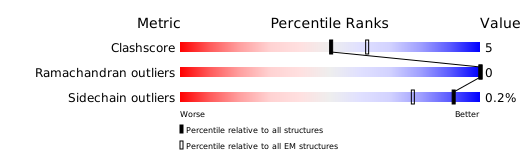
Structure validation
Download full validation report


