






 9GMP
9GMP
TKUL kinase domain from Leishmania mexicana
Summary for 9GMP
| Entry DOI | 10.2210/pdb9gmp/pdb |
| Descriptor | Uncharacterized protein (Map kinase kinase-like protein), DI(HYDROXYETHYL)ETHER, GLYCEROL, ... (4 entities in total) |
| Functional Keywords | kinase domain, phosphorylation, signaling protein |
| Biological source | Leishmania mexicana |
| Total number of polymer chains | 1 |
| Total formula weight | 31345.62 |
| Authors | Fokkens, T.J.,Wolter, M.,Lorenz, S. (deposition date: 2024-08-29, release date: 2025-09-24, Last modification date: 2026-04-08) |
| Primary citation | Fokkens, T.J.,Rauh, E.T.,Wolter, M.,Sebald, H.,Mitnacht, M.,Ainatzi, S.,Sprick, S.,Teschke, L.,Eisenhuth, N.,Huibregtse, J.M.,Butter, F.,Urlaub, H.,Karnkowska, A.,Steinchen, W.,Schleicher, U.,Janzen, C.J.,Lorenz, S. A Leishmania virulence factor harnesses an allosteric kinase switch to regulate its ubiquitin ligase activity. Mol.Cell, 85:3711-3728.e11, 2025 Cited by PubMed Abstract: Stringent control of ubiquitylation is a central requirement of signaling specificity in eukaryotes. Here, we discover a domain module integrating protein kinase and ubiquitin ligase domains within a single protein. This module is widespread across unicellular eukaryotic lineages and particularly conserved in Leishmania, the causative agents of major neglected tropical diseases with a strong therapeutic need. We reveal that a gene encoding the module, tetratricopeptide repeat (TPR)-kinase-ubiquitin ligase (TKUL), is essential for L. mexicana to sustain macrophage infections and that TKUL can cooperate with parasite heat shock protein 70 (HSP70) to modify unfolded proteins with degradative ubiquitin chains. Intriguingly, the homologous to E6AP C-terminus (HECT)-type ubiquitin ligase activity of TKUL requires its atypical kinase domain, with kinase autophosphorylation triggering activating conformational changes across the catalytic module. Consistent with the ligase domain harnessing the kinase domain for regulation, TKUL-driven ubiquitylation can allosterically be suppressed by small-molecule kinase inhibitors. Together, this work establishes an unprecedented allosteric coupling mechanism in the realms of phosphorylation and ubiquitylation. PubMed: 40997810DOI: 10.1016/j.molcel.2025.09.002 PDB entries with the same primary citation |
| Experimental method | X-RAY DIFFRACTION (1.89 Å) |
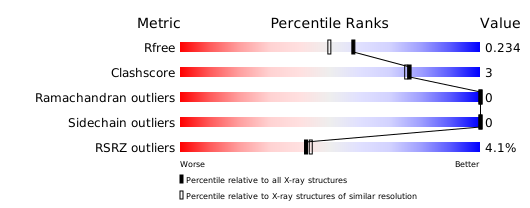
Structure validation
Download full validation report


