






 9GMC
9GMC
Crystal structure of the complex formed between the radical SAM protein ChlB and the R3A mutant of ChlA
Summary for 9GMC
| Entry DOI | 10.2210/pdb9gmc/pdb |
| Descriptor | ChlB radical SAM domain, ChlA R3A mutant, IRON/SULFUR CLUSTER, ... (6 entities in total) |
| Functional Keywords | radical sam protein ribosomally synthesised and post-translationally modified peptides iron sulfur clusters peptide binding protein, oxidoreductase |
| Biological source | Fischerella More |
| Total number of polymer chains | 4 |
| Total formula weight | 106482.48 |
| Authors | de la Mora, E.,Ruel, J.,Usclat, A.,Martin, L.,Amara, P.,Morinaka, B.,Nicolet, Y. (deposition date: 2024-08-28, release date: 2025-06-25, Last modification date: 2026-09-02) |
| Primary citation | Ruel, J.,Nguyen, T.Q.N.,Morishita, Y.,Usclat, A.,Martin, L.,Amara, P.,Kieffer-Jaquinod, S.,Stefanoiu, M.C.,de la Mora, E.,Morinaka, B.I.,Nicolet, Y. Peptide Recognition and Mechanism of the Radical S -Adenosyl-l-methionine Multiple Cyclophane Synthase ChlB. J.Am.Chem.Soc., 147:16850-16863, 2025 Cited by PubMed Abstract: Ribosomally synthesized and post-translationally modified peptides (RiPPs) represent a valuable class of natural products, often featuring macrocyclization, which enhances stability and rigidity to achieve specific conformations, frequently underlying antibiotic activity. ChlB is a metalloenzyme with two catalytic domains─a radical -adenosyl-l-methionine (SAM) domain and an α-ketoglutarate-dependent oxygenase─that work in tandem to sequentially form three cyclophanes and introduce three hydroxyl groups into its substrate peptide, ChlA. Here, we present the crystal structure of the radical SAM domain of ChlB in complex with ChlA, revealing the mechanism underlying cyclophane formation. These structures also elucidate how the leader sequence of ChlA interacts with ChlB. By combining structural, in vitro, and in vivo approaches, we determined the precise sequence of the three cyclophane formations, interspersed with hydroxylation events. Our findings demonstrate a back-and-forth movement of the core peptide between the radical SAM domain and the oxygenase domain, which drives the stepwise modification process, leading to the fully modified peptide. PubMed: 40354606DOI: 10.1021/jacs.4c16004 PDB entries with the same primary citation |
| Experimental method | X-RAY DIFFRACTION (1.77 Å) |
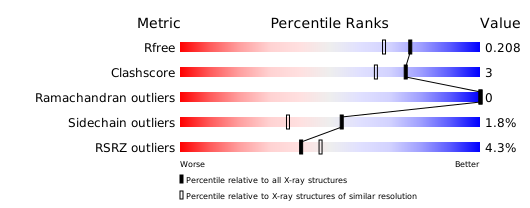
Structure validation
Download full validation report


