






 9GG5
9GG5
Cryo-EM structure of Thromboxane A2 receptor-miniGq protein complex bound to U46619
9GG5 の概要
| エントリーDOI | 10.2210/pdb9gg5/pdb |
| EMDBエントリー | 51324 |
| 分子名称 | Thromboxane A2 receptor, Engineered miniGq, Guanine nucleotide-binding protein G(I)/G(S)/G(T) subunit beta-1, ... (6 entities in total) |
| 機能のキーワード | single particle cryo-em, gpcr, g-proteins, membrane protein |
| 由来する生物種 | Homo sapiens (human) 詳細 |
| タンパク質・核酸の鎖数 | 4 |
| 化学式量合計 | 112722.98 |
| 構造登録者 | Matzov, D.,Krawinski, P.,Caffrey, M.,Shalev Benami, M. (登録日: 2024-08-13, 公開日: 2025-08-27, 最終更新日: 2026-04-15) |
| 主引用文献 | Krawinski, P.,Matzov, D.,Ryder, A.,Lal, K.,Karlov, D.S.,Chalhoub, G.,Mulvaney, E.P.,Kinsella, B.T.,McCormick, P.J.,Caffrey, M.,Tikhonova, I.G.,Shalev-Benami, M. Structural and dynamic insights into agonist recognition and function of the thromboxane A 2 receptor. Nat Commun, 17:-, 2026 Cited by PubMed Abstract: The thromboxane A receptor (TP), expressed in platelets and smooth muscle, plays an important role in blood clotting and muscle contraction. The endogenous ligand of this G protein-coupled receptor (GPCR), thromboxane A (TXA), is a short-lived arachidonic acid metabolite with a half-life of ∼30 seconds, which makes investigating the TP structure and activation mechanism highly challenging. Here we determine the structures of the TP in complex with the synthetic agonists, U46619 and I-BOP, stable analogues of the natural ligand, in the presence of the signalling protein partner, G. The structures reveal a unique activation switch for the receptor that differs from typical class A GPCR family members. Complemented by functional studies, mutational analysis, docking, and molecular dynamics (MD) simulations, our investigation highlights the differences between agonist and antagonist binding and explores the ligand entry mechanism to the binding pocket from within the membrane via a molecular gate composed of two transmembrane helices. In addition, our study provides crucial information to aid in the rational design of compounds targeting the TP, and offers mechanistic insights into inherited disorders associated with mutations in the TP. PubMed: 41730883DOI: 10.1038/s41467-026-69844-9 主引用文献が同じPDBエントリー |
| 実験手法 | ELECTRON MICROSCOPY (3.26 Å) |
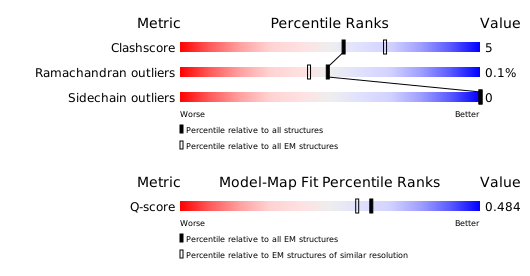
構造検証レポート
検証レポート(詳細版) をダウンロード
をダウンロード


