






 9GF7
9GF7
SARS-CoV2 Main Protease (Mpro) in complex with the covalent inhibitor 28a
This is a non-PDB format compatible entry.
Summary for 9GF7
| Entry DOI | 10.2210/pdb9gf7/pdb |
| Descriptor | 3C-like proteinase nsp5, ~{N}-[(2~{S})-4-methyl-1-oxidanylidene-1-[[(2~{S})-1-oxidanylidene-3-[(3~{S})-2-oxidanylidenepyrrolidin-3-yl]propan-2-yl]amino]pentan-2-yl]quinoline-8-carboxamide (3 entities in total) |
| Functional Keywords | protease, inhibitor, complex, viral protein |
| Biological source | Severe acute respiratory syndrome coronavirus 2 |
| Total number of polymer chains | 1 |
| Total formula weight | 34250.04 |
| Authors | |
| Primary citation | Rossi, S.,Deidda, G.,Fiaschi, L.,Ibba, R.,Pieroni, M.,Dichiara, M.,Carullo, G.,Butini, S.,Ramunno, A.,Brogi, S.,Lolicato, M.,Arrigoni, C.,Cabella, N.,Bavagnoli, L.,Maga, G.,Varasi, I.,Biba, C.,Vicenti, I.,Gemma, S.,Crespan, E.,Zazzi, M.,Campiani, G. Synthesis and biological investigation of peptidomimetic SARS-CoV-2 main protease inhibitors bearing quinoline-based heterocycles at P 3. Arch Pharm, 358:e2400812-e2400812, 2025 Cited by PubMed Abstract: In the last few years, severe acute respiratory syndrome coronavirus 2 (SARS-CoV-2) has been the cause of a worldwide pandemic, highlighting the need for novel antiviral agents. The main protease (M) of SARS-CoV-2 was immediately identified as a crucial enzyme for viral replication and has been validated as a drug target. Here, we present the design and synthesis of peptidomimetic M covalent inhibitors characterized by quinoline-based P moieties. Structure-activity relationships (SARs) were also investigated at P and P, as well as for different warheads. The binding modes of the designed inhibitors were assessed using X-ray crystallographic and molecular docking studies. The identified M inhibitors were tested for their antiviral activities in cell-based assays, and the results were encouraging. The SAR studies presented here can contribute to the future design of improved inhibitors by addressing some of the current or prospective issues regarding M inhibitors currently used in therapy. PubMed: 39873316DOI: 10.1002/ardp.202400812 PDB entries with the same primary citation |
| Experimental method | X-RAY DIFFRACTION (1.9 Å) |
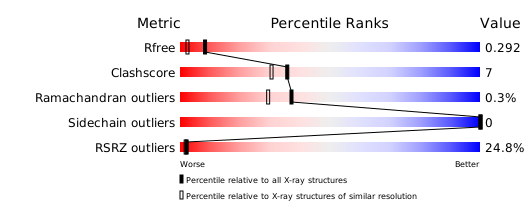
Structure validation
Download full validation report


