






 9GEX
9GEX
Escherichia coli NrdR with unocuppied outer nucleotide-binding site
Summary for 9GEX
| Entry DOI | 10.2210/pdb9gex/pdb |
| Descriptor | Transcriptional repressor NrdR, ZINC ION, GLYCEROL, ... (6 entities in total) |
| Functional Keywords | rnr transcriptional repressor, zinc finger domain, atp cone domain, dna binding protein |
| Biological source | Escherichia coli K-12 |
| Total number of polymer chains | 4 |
| Total formula weight | 71675.90 |
| Authors | Szura, A.,Schmitz, C.,Pedraz, L.,Torrents, E.,Sola, M. (deposition date: 2024-08-07, release date: 2026-02-18, Last modification date: 2026-07-08) |
| Primary citation | Pedraz, L.,Szura, A.,Schmitz, C.,Rubio-Canalejas, A.,Martinez-Mateos, A.,Santella, A.,Gomila, G.,Calo, A.,Sola, M.,Torrents, E. Structure and mechanistic basis of NrdR, a bacterial master regulator of ribonucleotide reduction. Int.J.Biol.Macromol., 350:150647-150647, 2026 Cited by PubMed Abstract: Ribonucleotide reductases (RNRs) are the essential enzymes responsible for synthesizing dNTPs, the building blocks of DNA. In bacteria, the entire RNR network is controlled by the master regulator NrdR. As a regulator of an essential pathway with no eukaryotic equivalent, NrdR is a promising antimicrobial target. Recent structural studies have outlined a mechanism of action for NrdR, in which ATP and dATP induce changes in the protein quaternary structure, regulating RNR repression. However, due to a lack of functional studies linking the known structures to their biological roles, the activation mechanism of NrdR is not yet fully understood. Here, we conducted a comprehensive study of NrdR in Escherichia coli and Pseudomonas aeruginosa. We delimited the NrdR regulon, combining transcriptomics and motif-based sequence analysis. We crystallized E. coli NrdR and identified the protein-protein interfaces involved in its oligomerization, including strong interactions between NrdR dimers to form tetramers, and less stable interfaces connecting such tetramers. We examined the variability of the quaternary structures of NrdR depending on the bound nucleotides by SEC-MALS and atomic force microscopy, and correlated structure to function using point mutations, EMSAs, and in vitro transcription assays. Overall, our results demonstrate the mechanism used by NrdR to modulate its quaternary structure and activity, deciphering essential interactions between subunits, and paving the way for targeted antimicrobial therapies. PubMed: 41651256DOI: 10.1016/j.ijbiomac.2026.150647 PDB entries with the same primary citation |
| Experimental method | X-RAY DIFFRACTION (2.6 Å) |
Structure validation
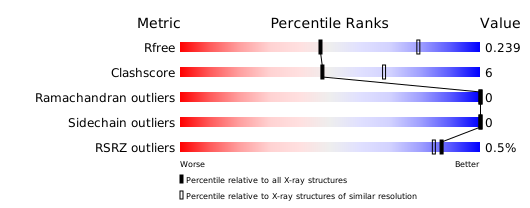
Download full validation report


