






 9G7Q
9G7QSummary for 9G7Q
| Entry DOI | 10.2210/pdb9g7q/pdb |
| Descriptor | StayRose, CHLORIDE ION, 1,2-ETHANEDIOL, ... (4 entities in total) |
| Functional Keywords | modified amino acid, fluorescent protein |
| Biological source | Cytaeis uchidae |
| Total number of polymer chains | 2 |
| Total formula weight | 53148.09 |
| Authors | Crow, A. (deposition date: 2024-07-22, release date: 2025-05-21, Last modification date: 2025-11-26) |
| Primary citation | Scott, W.,Ivorra-Molla, E.,Akhuli, D.,Massam-Wu, T.,Lysyganicz, P.K.,Walsh, R.,Parent, M.,Cook, J.,Song, L.,Kumar, A.,Schneider, F.,Mishima, M.,Crow, A.,Balasubramanian, M.K. StayRose: A photostable StayGold derivative redshifted by genetic code expansion. J.Biol.Chem., 301:110832-110832, 2025 Cited by PubMed Abstract: Photobleaching of fluorescent proteins often limits the acquisition of high-quality images in microscopy. StayGold, a novel dimeric GFP recently monomerized through sequence engineering, addresses this challenge with its high photostability. There is now a focus on producing different colored StayGold derivatives to facilitate concurrent tagging of multiple targets. The unnatural amino acid 3-aminotyrosine has previously been shown to redshift superfolder GFP upon incorporation into its chromophore via genetic code expansion. Here, we apply the same strategy to redshift StayGold through substitution of tyrosine-58 with 3-aminotyrosine. The resultant red fluorescent protein, StayRose, shows an excitation wavelength maximum of 530 nm and an emission wavelength maximum of 588 nm. Importantly, the monomeric mStayRose retains the favorable photostability in vivo in Escherichia coli and zebrafish embryos. A high-resolution crystal structure of StayRose confirms the modified structure of the amino chromophore within an unperturbed 3D fold. Although reliant on genetic code expansion, StayRose provides an important step toward developing redshifted StayGold derivatives. PubMed: 41109344DOI: 10.1016/j.jbc.2025.110832 PDB entries with the same primary citation |
| Experimental method | X-RAY DIFFRACTION (1.65 Å) |
Structure validation
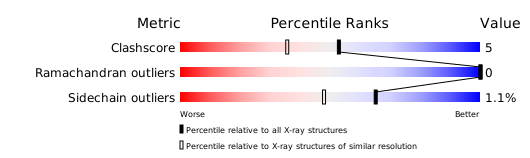
Download full validation report


