






 9G6E
9G6E
CLC7(Y715C)/OSTM1 complex
Summary for 9G6E
| Entry DOI | 10.2210/pdb9g6e/pdb |
| EMDB information | 51099 |
| Descriptor | H(+)/Cl(-) exchange transporter 7, Osteopetrosis-associated transmembrane protein 1, alpha-D-mannopyranose-(1-3)-[alpha-D-mannopyranose-(1-6)]beta-D-mannopyranose-(1-4)-2-acetamido-2-deoxy-beta-D-glucopyranose-(1-4)-2-acetamido-2-deoxy-beta-D-glucopyranose, ... (5 entities in total) |
| Functional Keywords | lysosomal transporter, ph regulation, membrane complex, transporter, membrane protein |
| Biological source | Homo sapiens (human) More |
| Total number of polymer chains | 4 |
| Total formula weight | 258057.06 |
| Authors | Lin, Y.,Deme, J.C.,Lea, S.M.,Newstead, S. (deposition date: 2024-07-18, release date: 2025-07-30, Last modification date: 2025-12-10) |
| Primary citation | Hilton, J.K.,Lin, Y.,Sefah, E.,Deme, J.C.,Parker, J.L.,Langton, M.J.,Grabe, M.,Lea, S.,Newstead, S.,Mindell, J.A. Mechanism of phosphoinositide regulation of lysosomal pH via inhibition of CLC-7. Biorxiv, 2025 Cited by PubMed Abstract: Lysosomes process cellular waste and coordinate responses to metabolic challenge. Central to lysosomal homeostasis are phosphoinositide lipids, key signaling molecules which establish organelle identity, regulate membrane dynamics and are tightly linked to the pathophysiology and therapy of lysosomal storage disorders, neurodegeneration, and cancer. Phosphatidylinositol 3,5-bisphosphate (PI(3,5)P2) interacts with multiple lysosomal membrane proteins and plays a critical role in regulating lysosomal pH by directly inhibiting the chloride/proton antiporter ClC-7, though the molecular mechanism of this inhibition remains unclear. Here, using a combination of functional, structural, and computational analysis, we demonstrate that PI(3,5)P2 binding dramatically remodels the structure of ClC-7 by inducing close association between cytosolic and transmembrane domains. Disease-causing mutations show increased transport activity through loss of PI(3,5)P2 binding and subsequent inhibition. Conversely, ClC-7 activation is correlated with dissociation and increased disorder of the cytoplasmic domain along with novel transmembrane domain conformations, revealing a mechanistic link between specific lysosomal lipids, transporter regulation, and the enigmatic basis of the ClC-7 slow gate. PubMed: 41256531DOI: 10.1101/2025.10.01.679551 PDB entries with the same primary citation |
| Experimental method | ELECTRON MICROSCOPY (2.6 Å) |
Structure validation
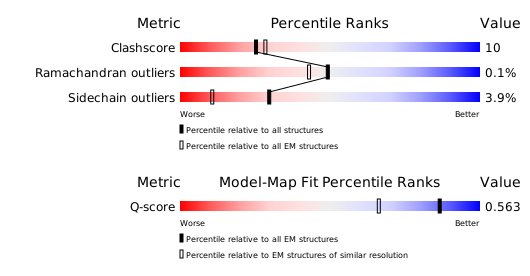
Download full validation report


