






 9G08
9G08
Structure of human RNF213 bound to the secreted effector IpaH1.4 from Shigella flexneri
Summary for 9G08
| Entry DOI | 10.2210/pdb9g08/pdb |
| EMDB information | 50913 |
| Descriptor | E3 ubiquitin-protein ligase RNF213, E3 ubiquitin-protein ligase IpaH1.4, ADENOSINE-5'-TRIPHOSPHATE, ... (5 entities in total) |
| Functional Keywords | rnf213, ipah1.4, ipah, e3 ligase, ring, lrr, nel, secreted effector, shigella, inhibitor, complex, aaa atpase, antimicrobial protein |
| Biological source | Homo sapiens (human) More |
| Total number of polymer chains | 2 |
| Total formula weight | 662103.06 |
| Authors | Naydenova, K.,Randow, F. (deposition date: 2024-07-07, release date: 2025-04-16, Last modification date: 2025-10-01) |
| Primary citation | Naydenova, K.,Boyle, K.B.,Pathe, C.,Pothukuchi, P.,Crespillo-Casado, A.,Scharte, F.,Hammoudi, P.M.,Otten, E.G.,Alto, N.M.,Randow, F. Shigella flexneri evades LPS ubiquitylation through IpaH1.4-mediated degradation of RNF213. Nat.Struct.Mol.Biol., 32:1741-1751, 2025 Cited by PubMed Abstract: Pathogens have evolved diverse strategies to counteract host immunity. Ubiquitylation of lipopolysaccharide (LPS) on cytosol-invading bacteria by the E3 ligase RNF213 creates 'eat me' signals for antibacterial autophagy, but whether and how cytosol-adapted bacteria avoid LPS ubiquitylation remains poorly understood. Here, we show that the enterobacterium Shigella flexneri actively antagonizes LPS ubiquitylation through IpaH1.4, a secreted effector protein with ubiquitin E3 ligase activity. IpaH1.4 binds to RNF213, ubiquitylates it and targets it for proteasomal degradation, thus counteracting host-protective LPS ubiquitylation. To understand how IpaH1.4 recognizes RNF213, we determined the cryogenic electron microscopy structure of the IpaH1.4-RNF213 complex. The specificity of the interaction is achieved through the leucine-rich repeat of IpaH1.4, which binds the RING domain of RNF213 by hijacking the conserved RING interface required for binding to ubiquitin-charged E2 enzymes. IpaH1.4 also targets other E3 ligases involved in inflammation and immunity through binding to the E2-interacting face of their RING domains, including the E3 ligase LUBAC that is required for the synthesis of M1-linked ubiquitin chains on cytosol-invading bacteria downstream of RNF213. We conclude that IpaH1.4 has evolved to antagonize multiple antibacterial and proinflammatory host E3 ligases. PubMed: 40205224DOI: 10.1038/s41594-025-01530-8 PDB entries with the same primary citation |
| Experimental method | ELECTRON MICROSCOPY (3.3 Å) |
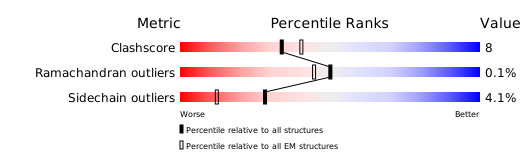
Structure validation
Download full validation report


