






 9FW7
9FW7
Retroaldolase 32 (RAD32)
Summary for 9FW7
| Entry DOI | 10.2210/pdb9fw7/pdb |
| Related | 9FW5 |
| Descriptor | Retroaldolase 32 (RAD32) (2 entities in total) |
| Functional Keywords | retroaldolase, de novo enzyme, rfdiffusion, de novo protein |
| Biological source | synthetic construct |
| Total number of polymer chains | 1 |
| Total formula weight | 22922.45 |
| Authors | Bijelic, A.,Braun, M.,Stoll, D.,Tripp, A.,Chakatok, M.,Oberdorfer, G. (deposition date: 2024-06-28, release date: 2025-07-09, Last modification date: 2026-01-07) |
| Primary citation | Braun, M.,Tripp, A.,Chakatok, M.,Kaltenbrunner, S.,Fischer, C.,Stoll, D.,Bijelic, A.,Elaily, W.,Totaro, M.G.,Moser, M.,Hoch, S.Y.,Lechner, H.,Rossi, F.,Aleotti, M.,Hall, M.,Oberdorfer, G. Computational enzyme design by catalytic motif scaffolding. Nature, 649:237-245, 2026 Cited by PubMed Abstract: Enzymes find broad use as biocatalysts in industry and medicine owing to their exquisite selectivity, efficiency and mild reaction conditions. Custom-designed enzymes can produce tailor-made biocatalysts with potential applications that extend beyond natural reactions. However, current design methods require testing a large number of designs and mostly produce de novo enzymes with low catalytic activities. As a result, they require costly experimental optimization and high-throughput screening to be industrially viable. Here we present rotamer inverted fragment finder-diffusion (Riff-Diff), a hybrid machine learning and atomistic modelling strategy for scaffolding catalytic arrays in de novo proteins. We highlight the general applicability of Riff-Diff by designing enzymes for two mechanistically distinct chemical transformations, the retro-aldol reaction and the Morita-Baylis-Hillman reaction. We show that in both cases, it is possible to generate catalysts that exhibit activities rivalling those optimized by in vitro evolution, along with exquisite stereoselectivity. High-resolution structures of six of the designs revealed near-atomic active site design precision. The design strategy can, in principle, be applied to any catalytically competent amino acid array. These findings lay the basis for practical applicability of de novo protein catalysts in synthesis and describe fundamental principles of protein design and enzyme catalysis. PubMed: 41339546DOI: 10.1038/s41586-025-09747-9 PDB entries with the same primary citation |
| Experimental method | X-RAY DIFFRACTION (2 Å) |
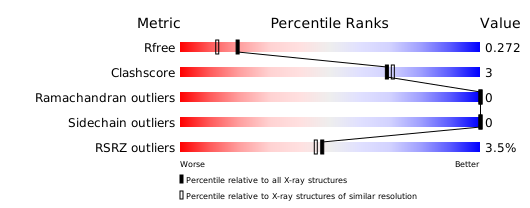
Structure validation
Download full validation report


