






 9FQY
9FQY
Pseudomonas aeruginosa Elastase in complex with a phosphonate based inhibitor (R-configured)
This is a non-PDB format compatible entry.
Summary for 9FQY
| Entry DOI | 10.2210/pdb9fqy/pdb |
| Descriptor | Elastase, ZINC ION, CALCIUM ION, ... (5 entities in total) |
| Functional Keywords | virulence factor, inhibitor, complex, hydrolase |
| Biological source | Pseudomonas aeruginosa |
| Total number of polymer chains | 1 |
| Total formula weight | 33747.41 |
| Authors | Klein, A.,Hirsch, A. (deposition date: 2024-06-17, release date: 2025-07-02, Last modification date: 2025-08-27) |
| Primary citation | Kiefer, A.F.,Schutz, C.,Englisch, C.N.,Kolling, D.,Speicher, S.,Kany, A.M.,Shafiei, R.,Wadood, N.A.,Aljohmani, A.,Wirschem, N.,Jumde, R.P.,Klein, A.,Sikandar, A.,Park, Y.M.,Krasteva-Christ, G.,Yildiz, D.,Abdelsamie, A.S.,Rox, K.,Kohnke, J.,Muller, R.,Bischoff, M.,Haupenthal, J.,Hirsch, A.K.H. Dipeptidic Phosphonates: Potent Inhibitors of Pseudomonas aeruginosa Elastase B Showing Efficacy in a Murine Keratitis Model. Adv Sci, 12:e2411807-e2411807, 2025 Cited by PubMed Abstract: The ubiquitous opportunistic pathogen Pseudomonas aeruginosa is responsible for severe infections and notoriously known for acquiring antimicrobial resistance. Inhibiting the bacterium's extracellular elastase, LasB - a zinc-dependent protease - presents a promising strategy to mitigate its virulence. Within this medicinal chemistry-driven hit-to-lead optimization campaign, a new series of highly potent dipeptidic phosphonates is designed and synthesized following a structure-based drug-discovery approach. In vitro and in vivo evaluation reveal beneficial pharmacokinetic profiles, excellent selectivity over human off-targets and good tolerability in murine toxicity studies. Ultimately, the scaffold presented herein demonstrates promising in vivo efficacy in a murine Pseudomonas aeruginosa keratitis model in combination with the antibiotic meropenem. PubMed: 39973061DOI: 10.1002/advs.202411807 PDB entries with the same primary citation |
| Experimental method | X-RAY DIFFRACTION (1.6 Å) |
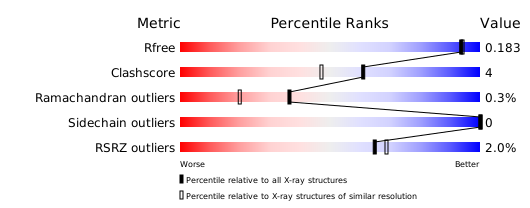
Structure validation
Download full validation report


