






 9FN1
9FN1
360 A Loki CHMP4-7 rods
Summary for 9FN1
| Entry DOI | 10.2210/pdb9fn1/pdb |
| EMDB information | 50583 |
| Descriptor | Vps20/32/60-like protein (ESCRT-III) (1 entity in total) |
| Functional Keywords | escrt-iii, membrane remodling, tubulation, archaea, loki, lipid binding protein |
| Biological source | Candidatus Lokiarchaeia archaeon |
| Total number of polymer chains | 1 |
| Total formula weight | 24739.96 |
| Authors | Melnikov, N.,Junglas, B.,Halbi, G.,Nachmias, D.,Upcher, A.,Zalk, R.,Sachse, C.,Bernheim-Groswasser, A.,Elia, N. (deposition date: 2024-06-07, release date: 2025-04-16, Last modification date: 2025-10-29) |
| Primary citation | Melnikov, N.,Junglas, B.,Halbi, G.,Nachmias, D.,Zerbib, E.,Gueta, N.,Upcher, A.,Zalk, R.,Sachse, C.,Bernheim-Groswasser, A.,Elia, N. The Asgard archaeal ESCRT-III system forms helical filaments and remodels eukaryotic-like membranes. Embo J., 44:665-681, 2025 Cited by PubMed Abstract: The ESCRT machinery mediates membrane remodeling in numerous processes in cells including cell division and nuclear membrane reformation. The identification of ESCRT homologs in Asgard archaea, currently considered the closest prokaryotic relative of eukaryotes, implies a role for ESCRTs in the membrane remodeling processes that occurred during eukaryogenesis. Yet, the function of these distant ESCRT homologs is mostly unresolved. Here we show that Asgard ESCRT-III proteins of the Lokiarcheota self-assemble into helical filaments, a hallmark of the ESCRT system. We determined the cryo-EM structure of the filaments at 3.6 Å resolution and found that they share features of bacterial and eukaryotic ESCRT-III assemblies. Markedly, Asgard ESCRT-III filaments bound and deformed eukaryotic-like membrane vesicles. Oligonucleotides facilitated the assembly of ESCRT-III filaments and tuned the extent of membrane remodeling. The ability of Asgard archaeal ESCRTs to remodel eukaryotic-like membranes, which are fundamentally different from archaeal membranes, and the structural properties of these proteins places them at the junction between prokaryotes and eukaryotes. PubMed: 39753954DOI: 10.1038/s44318-024-00346-4 PDB entries with the same primary citation |
| Experimental method | ELECTRON MICROSCOPY (3.55 Å) |
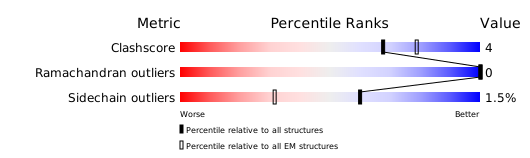
Structure validation
Download full validation report


