






 9FGY
9FGY
Cryo-EM structure of Lysozyme homo-dimer assembled by homo Di-Gluebody - Local refinement
Summary for 9FGY
| Entry DOI | 10.2210/pdb9fgy/pdb |
| EMDB information | 50433 |
| Descriptor | anti-Lysozyme Gluebody, Lysozyme C, GLYCEROL (3 entities in total) |
| Functional Keywords | gluebody, nanobody, cryo-em spa, small protein, protein binding |
| Biological source | Lama glama More |
| Total number of polymer chains | 2 |
| Total formula weight | 28286.69 |
| Authors | Yi, G.,Ye, M.,Mamalis, D.,Carrique, L.,Fairhead, M.,Li, H.,Duerr, K.,Zhang, P.,Sauer, D.B.,von Delft, F.,Davis, B.G.,Gilbert, R.J.C. (deposition date: 2024-05-26, release date: 2025-06-11, Last modification date: 2026-01-07) |
| Primary citation | Yi, G.,Mamalis, D.,Ye, M.,Carrique, L.,Fairhead, M.,Li, H.,Duerr, K.L.,Zhang, P.,Sauer, D.B.,von Delft, F.,Davis, B.G.,Gilbert, R.J.C. Covalently constrained 'Di-Gembodies' enable parallel structure solutions by cryo-EM. Nat.Chem.Biol., 22:69-76, 2026 Cited by PubMed Abstract: Whilst cryo-electron microscopy(cryo-EM) has become a routine methodology in structural biology, obtaining high-resolution cryo-EM structures of small proteins (<100 kDa) and increasing overall throughput remain challenging. One approach to augment protein size and improve particle alignment involves the use of binding proteins or protein-based scaffolds. However, a given imaging scaffold or linking module may prove inadequate for structure solution and availability of such scaffolds remains limited. Here, we describe a strategy that exploits covalent dimerization of nanobodies to trap an engineered, predisposed nanobody-to-nanobody interface, giving Di-Gembodies as modular constructs created in homomeric and heteromeric forms. By exploiting side-chain-to-side-chain assembly, they can simultaneously display two copies of the same or two distinct proteins through a subunit interface that provides sufficient constraint required for cryo-EM structure determination. We validate this method with multiple soluble and membrane structural targets, down to 14 kDa, demonstrating a flexible and scalable platform for expanded protein structure determination. PubMed: 40817135DOI: 10.1038/s41589-025-01972-7 PDB entries with the same primary citation |
| Experimental method | ELECTRON MICROSCOPY (3.16 Å) |
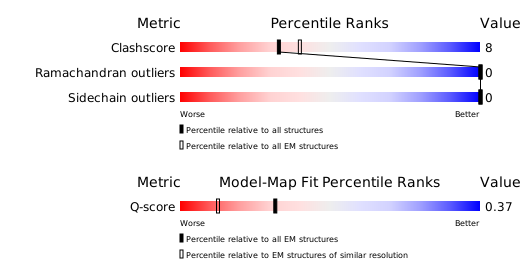
Structure validation
Download full validation report


