






 9F8Z
9F8Z
Structure of the mouse 8-oxoguanine DNA Glycosylase mOGG1 in complex with ligand TH13677
This is a non-PDB format compatible entry.
Summary for 9F8Z
| Entry DOI | 10.2210/pdb9f8z/pdb |
| Descriptor | N-glycosylase/DNA lyase, ~{N}4-(5-chloranyl-6-methoxy-pyridin-3-yl)-1~{H}-pyrazolo[3,4-d]pyrimidine-4,6-diamine, NICKEL (II) ION, ... (5 entities in total) |
| Functional Keywords | ogg1, dna binding protein |
| Biological source | Mus musculus (house mouse) |
| Total number of polymer chains | 3 |
| Total formula weight | 108188.10 |
| Authors | Scaletti, E.,Stenmark, P. (deposition date: 2024-05-07, release date: 2025-05-21, Last modification date: 2026-01-28) |
| Primary citation | Hank, E.C.,D'Arcy-Evans, N.D.,Scaletti, E.R.,Benitez-Buelga, C.,Wallner, O.,Ortis, F.,Zhou, K.,Meng, L.,Del Prado, A.,Calvo, P.,Almlof, I.,Wiita, E.,Nierlin, K.,Kosenina, S.,Kramer, A.,Eddershaw, A.,Kehler, M.,Long, M.,Jemth, A.S.,Dawson, H.,Stewart, J.,Dickey, A.,Astorga, M.E.,Varga, M.,Homan, E.J.,Scobie, M.,Knapp, S.,Sastre, L.,Stenmark, P.,de Vega, M.,Helleday, T.,Michel, M. Nucleobase catalysts for the enzymatic activation of 8-oxoguanine DNA glycosylase 1. Rsc Chem Biol, 7:169-181, 2026 Cited by PubMed Abstract: Bifunctional DNA glycosylases employ an active site lysine or the N-terminus to form a Schiff base with an abasic (AP) site base excision repair intermediate. For 8-oxoguanine DNA glycosylase 1 (OGG1), cleaving this reversible structure is the rate-determining step in the initiation of 8-oxoguanine (8-oxoG) repair in DNA. Evolution has led OGG1 to use a product-assisted catalysis approach, where the excised 8-oxoG acts as a Brønsted base for cleavage of a Schiff base intermediate. However, the physicochemical properties of 8-oxoG significantly limit the inherent enzymatic turnover leading to a weak, cellularly absent, AP lyase activity. We hypothesized that chemical synthesis of purine analogues enables access to complex structures that are suitable as product-like catalysts. Herein, the nucleobase landscape is profiled for its potential to increase OGG1 Schiff base cleavage. 8-Substituted 6-thioguanines emerge as potent and selective scaffolds enabling OGG1 to cleave AP sites opposite any canonical nucleobase by β-elimination. This effectively broadens the enzymatic substrate scope of OGG1, shaping a complete, artificial AP-lyase function. In addition, a second class of compounds, 6-substituted pyrazolo-[3,4-]-pyrimidines, stimulate OGG1 function at high pH, while thioguanines govern enzymatic control at acidic pH. This enables up to 20-fold increased enzyme turnover and a OGG1 β-elimination in conditions commonly not tolerated. The tool compounds employed here are non-toxic in cells and stimulate the repair of AP sites through a natural, APE1 dependent pathway, as opposed to previously reported β,δ-lyase stimulator TH10785. PubMed: 41195166DOI: 10.1039/d4cb00323c PDB entries with the same primary citation |
| Experimental method | X-RAY DIFFRACTION (2.503 Å) |
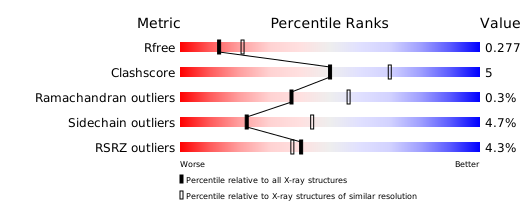
Structure validation
Download full validation report


