






 9F7E
9F7E
CtdA Canavanine tRNA-editing deacetylase from Pseudomonas canavaninivorans
Summary for 9F7E
| Entry DOI | 10.2210/pdb9f7e/pdb |
| Descriptor | CtdA Canavanyl tRNA Deacylase, SULFATE ION (3 entities in total) |
| Functional Keywords | editing, canavanine, arginine, trna editing, b3/b4 domain family, trna binding, rna binding protein |
| Biological source | Pseudomonas canavaninivorans |
| Total number of polymer chains | 2 |
| Total formula weight | 50293.03 |
| Authors | Tabagari, N.,Mayans, O. (deposition date: 2024-05-03, release date: 2025-05-14, Last modification date: 2026-02-11) |
| Primary citation | Tabagari, N.,Hauth, F.,Fleming, J.R.,Hartig, J.S.,Mayans, O. Indel-driven evolution of the canavanine tRNA-editing deacetylase enzyme CtdA. J Struct Biol X, 12:100132-100132, 2025 Cited by PubMed Abstract: Proteins are heteropolymers composed of twenty standard amino acids, but over 500 non-proteogenic amino acids exist in nature that can be misincorporated into proteins. Canavanine is an antimetabolite of the chemically similar L-arginine. It can be utilized by bacteria such as in the legume rhizome as a sole source of carbon and nitrogen. However, canavanine misincorporates in proteins of this bacterium as its arginyl-tRNA synthetase loads tRNA with both canavanine and arginine. Canavanyl-tRNA deacetylase (CtdA) removes canavanine from misloaded tRNA, preventing its protein toxicity, being the first enzyme known to edit tRNA mischarged with a non-proteinogenic amino acid. We have elucidated CtdA's crystal structure and studied its active site using site-directed mutagenesis. We found that CtdA is a small monomeric enzyme with a central, deep cavity that predictably is the canavanine binding site and a positively charged surface area that likely coordinates the CCA-3' tRNA attachment sequence. CtdA is distantly related to the B3/B4 -editing domains of the multi-subunit enzyme Phenylalanine-tRNA-Synthetase (PheRS). CdtA and B3/B4 domains from bacterial and archaeal/eukaryotic origin are three subclasses of a conserved 3D-fold that differ in type-specific indels, which shape the substrate binding site. We propose a class-unifying nomenclature of secondary structure for this fold. In CtdA, residues Y104, N105, E118 and E191 are relevant for catalysis, of which N105 is conserved in bacterial B3/B4 domains. Residue N105 is in proximity of the canavanyl-ribose junction and might coordinate the nucleophilic water molecule that attacks the substrate, possibly sharing a mechanistic role in CtdA and bacterial B3/B4 editing enzymes. PubMed: 40687620DOI: 10.1016/j.yjsbx.2025.100132 PDB entries with the same primary citation |
| Experimental method | X-RAY DIFFRACTION (1.5 Å) |
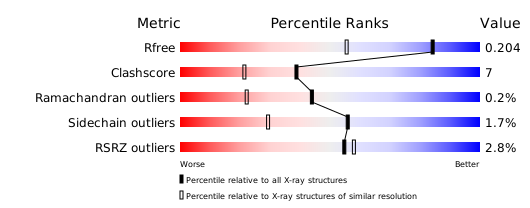
Structure validation
Download full validation report


