






 9EL0
9EL0Summary for 9EL0
| Entry DOI | 10.2210/pdb9el0/pdb |
| EMDB information | 48143 |
| Descriptor | Mucolipin-2, (3aS,4S,7R,7aS)-3-(2,6-dichlorophenyl)-3a,4,5,6,7,7a-hexahydro-4,7-methano-1,2-benzoxazole (2 entities in total) |
| Functional Keywords | trpml, calcium channel, ion transport, membrane protein |
| Biological source | Homo sapiens (human) |
| Total number of polymer chains | 4 |
| Total formula weight | 265193.85 |
| Authors | Schmiege, P.,Li, X. (deposition date: 2024-12-03, release date: 2025-06-18, Last modification date: 2026-01-07) |
| Primary citation | Schmiege, P.,Jaslan, D.,Fine, M.,Sadanandan, N.P.,Hatton, A.,Elghobashi-Meinhardt, N.,Grimm, C.,Li, X. TRPML2 in distinct states reveals the activation and modulation principles of the TRPML family. Nat Commun, 16:5325-5325, 2025 Cited by PubMed Abstract: TRPML2 activity is critical for endolysosomal integrity and chemokine secretion, and can be modulated by various ligands. Interestingly, two ML-SI3 isomers regulate TRPML2 oppositely. The molecular mechanism underlying this unique isomeric preference as well as the TRPML2 agonistic mechanism remains unknown. Here, we present six cryo-EM structures of human TRPML2 in distinct states revealing that the π-bulge of the S6 undergoes a π-α transition upon agonist binding, highlighting the remarkable role of the π-bulge in ion channel regulation. Moreover, we identify that PI(3,5)P allosterically affects the pose of ML2-SA1, a TRPML2 specific activator, resulting in an open channel without the π-α transition. Functional and structural studies show that mutating the S5 of TRPML1 to that of TRPML2 enables the mutated TRPML1 to be activated by (+)ML-SI3 and ML2-SA1. Thus, our work elucidates the activation mechanism of TRPML channels and paves the way for the development of selective TRPML modulators. PubMed: 40527873DOI: 10.1038/s41467-025-60710-8 PDB entries with the same primary citation |
| Experimental method | ELECTRON MICROSCOPY (2.45 Å) |
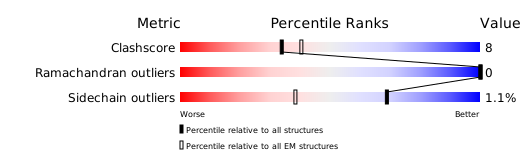
Structure validation
Download full validation report


