






 9EKA
9EKA
CRISPR-associated deaminase Cad1 in Apo form
Summary for 9EKA
| Entry DOI | 10.2210/pdb9eka/pdb |
| EMDB information | 48116 |
| Descriptor | CRISPR-associated ring nuclease and adenosine deaminase, subunit A, ZINC ION (2 entities in total) |
| Functional Keywords | crispr-associated carf ring nuclease, cad1, crispr-associated adenosine deaminase, s-adenosylmethionine, signaling protein, hydrolase |
| Biological source | Thermoanaerobaculum aquaticum |
| Total number of polymer chains | 6 |
| Total formula weight | 417387.25 |
| Authors | |
| Primary citation | Whyms, C.,Zhao, Y.,Addo-Yobo, D.,He, H.,Whittington, A.C.,Trasanidou, D.,Salazar, C.R.P.,Staals, R.H.J.,Li, H. The twist-and-squeeze activation of CARF-fused adenosine deaminase by cyclic oligoadenylates. Embo J., 44:6919-6943, 2025 Cited by PubMed Abstract: The recently identified CARF (CRISPR-associated Rossman-fold) family of proteins play a critical role in prokaryotic defense, mediating cOA (cyclic oligoadenylate)-stimulated ancillary immune responses in the type III CRISPR-Cas systems. Whereas most previously characterized CARF proteins contain nucleic acids or protein degradation effectors, a subset of the family, including the CARF-fused adenosine deaminase (ADA) (Cad1), has recently been shown to convert ATP to ITP. The enzymatic mechanism and the activation process of Cad1, however, remain incompletely understood. Here we present biochemical and structural analyses of a ring nuclease Cad1, revealing its substrate binding specificity and a sequential activation process by cOAs. Despite an overall structural similarity to canonical ADA enzymes, the ADA domain of Cad1 possesses unique structural features that confer a specificity for ATP. Supported by mutational analysis, our structural work demonstrates an allosteric link between the cOA-binding CARF and the ADA domain through a protein network within the hexameric enzyme assembly. Binding of a cA4 molecule to paired CARF domains induces a twisting of the linked ADA domains around one another, which remodels their active sites and alters interactions with neighboring ADA domains, thereby driving a sequential conformational activation mechanism. PubMed: 41107544DOI: 10.1038/s44318-025-00578-y PDB entries with the same primary citation |
| Experimental method | ELECTRON MICROSCOPY (3.1 Å) |
Structure validation
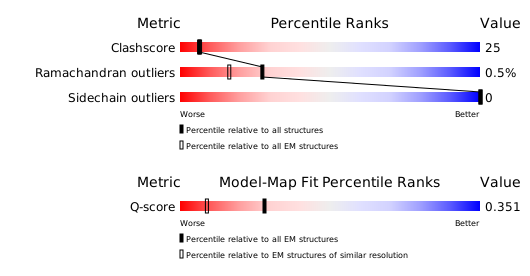
Download full validation report


