






 9EID
9EID
A broad-substrate spectrum lactate racemase A from Isosphaera pallida in complex with D-2-Hydroxybutyrate
Summary for 9EID
| Entry DOI | 10.2210/pdb9eid/pdb |
| Descriptor | A broad-substrate spectrum lactate racemase A, (2R)-2-oxidanylbutanoic acid, 3-methanethioyl-1-(5-O-phosphono-beta-D-ribofuranosyl)-5-(sulfanylcarbonyl)pyridin-1-ium, ... (6 entities in total) |
| Functional Keywords | catalytic activity, isomerase activity, racemase and epimerase activity racemase acting on hydroxy acids and derivatives, isomerase |
| Biological source | Isosphaera pallida |
| Total number of polymer chains | 1 |
| Total formula weight | 46605.82 |
| Authors | Gatreddi, S.,Hausinger, R.P.,Hu, J. (deposition date: 2024-11-25, release date: 2025-01-29, Last modification date: 2026-08-12) |
| Primary citation | Gatreddi, S.,Urdiain-Arraiza, J.,Desguin, B.,Hausinger, R.P.,Hu, J. Structural Basis for the Catalysis and Substrate Specificity of a LarA Racemase with a Broad Substrate Spectrum. Acs Catalysis, 15:2857-2866, 2025 Cited by PubMed Abstract: The LarA family consists of diverse racemases/epimerases that interconvert the diastereomers of α-hydroxyacids by using a nickel-pincer nucleotide (NPN) cofactor. The hidden redox reaction catalyzed by the NPN cofactor makes LarA enzymes attractive engineering targets for various applications. However, how a LarA enzyme binds its natural substrate and recognizes different α-hydroxyacids has not been elucidated. Here, we report three high-resolution structures of the enzyme-substrate complexes of a broad-spectrum LarA enzyme from (LarA ). The substrate binding mode reveals a near-optimal orientation and distance between the hydride donor and acceptor, consistent with an updated proton-coupled hydride transfer mechanism. The experimentally solved structures, together with the structural models of other LarA enzymes, lead to the identification of the residues/structural elements that are critically involved in the interactions with different α-hydroxyacids. Collectively, this work provides a structural basis for the catalysis and substrate specificity of the LarA enzymes. PubMed: 40013250DOI: 10.1021/acscatal.4c07804 PDB entries with the same primary citation |
| Experimental method | X-RAY DIFFRACTION (1.38 Å) |
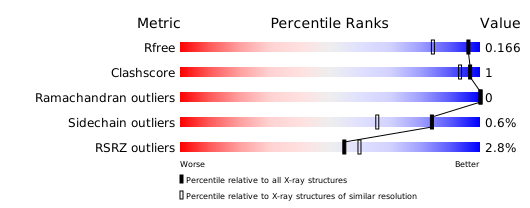
Structure validation
Download full validation report


