






 9EHZ
9EHZ
Cryo-EM structure of Human RNA polymerase II Elongation Complex in an Intermediate Translocation State
Summary for 9EHZ
| Entry DOI | 10.2210/pdb9ehz/pdb |
| EMDB information | 48071 |
| Descriptor | DNA-directed RNA polymerase II subunit RPB4, Non-template DNA, nucleic acid scaffold, RNA, nucleic acid scaffold, ... (17 entities in total) |
| Functional Keywords | translocation, human rna polymerase ii, transcription, transferase-dna-rna complex, transferase/dna/rna |
| Biological source | Homo sapiens (human) More |
| Total number of polymer chains | 15 |
| Total formula weight | 546221.25 |
| Authors | Florez Ariza, A.,Lue, N.,Nogales, E. (deposition date: 2024-11-25, release date: 2025-03-05, Last modification date: 2025-09-24) |
| Primary citation | Florez Ariza, A.J.,Lue, N.Z.,Grob, P.,Kaeser, B.,Fang, J.,Kassube, S.A.,Nogales, E. Structural insights into transcriptional regulation by the helicase RECQL5. Nat.Struct.Mol.Biol., 32:1721-1730, 2025 Cited by PubMed Abstract: Transcription poses a major challenge for genome stability. The RECQL5 helicase helps safeguard genome integrity and is the only member of the human RecQ helicase family that directly binds to RNA polymerase II (Pol II) and affects its progression. While RECQL5 mitigates transcription stress in cells, the molecular mechanism underlying this phenomenon is unclear. Here, we use cryo-electron microscopy to determine the structures of stalled human Pol II elongation complexes (ECs) bound to RECQL5. Our structures reveal the molecular interactions stabilizing RECQL5 binding to the Pol II EC and highlight its role as a transcriptional roadblock. Additionally, we find that, in its nucleotide-free state, RECQL5 twists the downstream DNA in the EC and, upon nucleotide binding, undergoes a conformational change that allosterically induces Pol II toward a post-translocation state. We propose that this mechanism may help restart Pol II elongation and, therefore, contribute to reducing transcription stress. PubMed: 40624164DOI: 10.1038/s41594-025-01611-8 PDB entries with the same primary citation |
| Experimental method | ELECTRON MICROSCOPY (2.6 Å) |
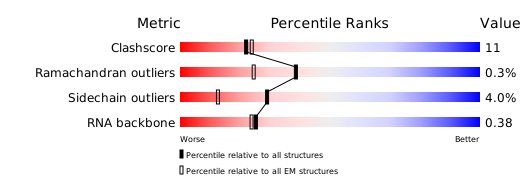
Structure validation
Download full validation report


