






 9EFW
9EFW
Co-crystal structure of yeast Forkhead transcription factor Fkh1 bound to DNA
Summary for 9EFW
| Entry DOI | 10.2210/pdb9efw/pdb |
| Descriptor | Fork head protein homolog 1, DNA, POTASSIUM ION, ... (5 entities in total) |
| Functional Keywords | dna binding, transcription factor, dna shape readout, forkhead proteins, dna binding protein, dna binding protein-dna complex, dna binding protein/dna |
| Biological source | Saccharomyces cerevisiae (brewer's yeast) More |
| Total number of polymer chains | 6 |
| Total formula weight | 51906.03 |
| Authors | Wang, G.L.,Jiang, Y.,Sun, Y.,Nasertorabi, F.,Batyuk, A.,Aparicio, O.M.,Cherezov, V.,Rohs, R. (deposition date: 2024-11-20, release date: 2025-09-24, Last modification date: 2025-10-08) |
| Primary citation | Wang, G.L.,Jiang, Y.,Sun, Y.,Nasertorabi, F.,Weller, J.A.,Mitra, R.,Batyuk, A.,Aparicio, O.M.,Cherezov, V.,Rohs, R. Novel fold and wing structure of Forkhead transcription factor facilitate DNA binding. Nucleic Acids Res., 53:-, 2025 Cited by PubMed Abstract: Forkhead homologue 1 (Fkh1) is a yeast transcription factor that plays essential roles in cell-cycle dynamics. Here, we report the co-crystal structure of the DNA-binding domain (DBD) of the yeast Fkh1 protein in complex with a 19-base pair oligonucleotide containing the core binding site and flanking regions. The three-dimensional structure of the Fkh1-DBD reveals a previously unknown protein fold among all known Forkhead proteins. The winged-helix fold forms base-specific contacts of α-helix H3 with the major groove of the core binding site. Wing 1 and Wing 2 form DNA shape-mediated contacts with the minor groove of the binding site flanking regions. The conformation of Wing 2 is distinct from all known Forkhead proteins, with α-helices H5 and H6 wrapping back onto the protein core, creating a stable Wing 2 loop. Backbone interactions with β-strands S1 and S2 reveal a structural mechanism for previously observed flanking region preferences in SELEX-seq experiments. In vivo yeast experiments on Fkh1 mutants demonstrate that wing residues interacting with flanking regions are important for Fkh1 function. Molecular dynamics simulations relate Fkh1 function to conformational flexibility of wing residues. The novel Forkhead fold enables Fkh1 function with implications, such as structure-based protein design, for other DNA-binding proteins. PubMed: 40990245DOI: 10.1093/nar/gkaf946 PDB entries with the same primary citation |
| Experimental method | X-RAY DIFFRACTION (2.2 Å) |
Structure validation
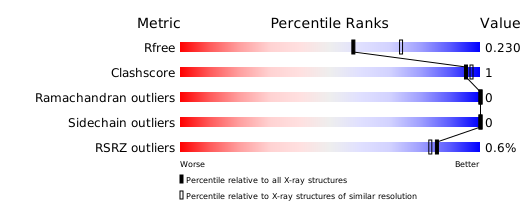
Download full validation report


