






 9EFM
9EFM
Cryo-EM structure of COP9 signalosome precatalytic state with neddylated cullin-1
Summary for 9EFM
| Entry DOI | 10.2210/pdb9efm/pdb |
| EMDB information | 47976 |
| Descriptor | COP9 signalosome complex subunit 1, Cullin-1, E3 ubiquitin-protein ligase RBX1, ... (12 entities in total) |
| Functional Keywords | cop9, cop9 signalosome, signalosome, deneddylation, csn5, n8cul1, csn, signaling protein |
| Biological source | Homo sapiens (human) More |
| Total number of polymer chains | 11 |
| Total formula weight | 439559.48 |
| Authors | |
| Primary citation | Shi, H.,Wang, X.,Yu, C.,Mao, H.,Jiao, F.,Braitbard, M.,Shor, B.,Zhang, Z.,Hinds, T.R.,Cao, S.,Fan, E.,Schneidman-Duhovny, D.,Huang, L.,Zheng, N. CSN5i-3 is an orthosteric molecular glue inhibitor of COP9 signalosome. Nature, 652:1375-1383, 2026 Cited by PubMed Abstract: Orthosteric inhibitors block enzyme active sites and prevent substrates from binding. Enhancing their specificity through substrate dependence seems inherently unlikely, as their mechanism hinges on direct competition rather than selective recognition. Here we show that a molecular glue mechanism unexpectedly imparts substrate-dependent potency to CSN5i-3, an orthosteric inhibitor of the COP9 signalosome (CSN). We first confirm that CSN5i-3 inhibits CSN, which catalyses NEDD8 (N8) deconjugation from the cullin-RING ubiquitin ligases, by occupying the active site of its catalytic subunit, CSN5, and directly competing with the iso-peptide bond substrate. Notably, the orthosteric inhibitor binds free CSN with only micromolar affinity, yet achieves nanomolar potency in blocking its deneddylase activity. Cryogenic electron microscopy structures of the enzyme-substrate-inhibitor complex reveal that active site-engaged CSN5i-3 occludes the substrate iso-peptide linkage while simultaneously extending an N8-binding exosite of CSN5, acting as a molecular glue to cement the N8-CSN5 interaction. The cooperativity of this trimolecular CSN5i-3-N8-CSN5 assembly, in turn, sequesters CSN5i-3 at its binding site, conferring high potency to the orthosteric inhibitor despite its low affinity for the free enzyme. Together, our findings highlight the modest affinity requirements of molecule glues for individual target proteins and establish orthosteric molecular glue inhibitors as a new class of substrate-dependent enzyme antagonists. PubMed: 41673158DOI: 10.1038/s41586-026-10129-y PDB entries with the same primary citation |
| Experimental method | ELECTRON MICROSCOPY (3.16 Å) |
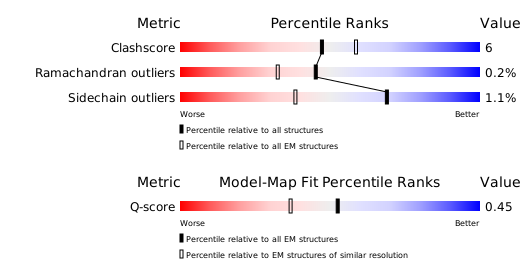
Structure validation
Download full validation report


