






 9E9N
9E9N
Ligand Free Putative Ancestral Protein Tyrosine Phosphatase ShufPTP - Lowest p-loop Conformation
Summary for 9E9N
| Entry DOI | 10.2210/pdb9e9n/pdb |
| Descriptor | ShufPTP, GLYCEROL, DI(HYDROXYETHYL)ETHER, ... (4 entities in total) |
| Functional Keywords | phosphatase, inhibitor, asr, cso, oxidized cystine, hydrolase |
| Biological source | synthetic construct |
| Total number of polymer chains | 1 |
| Total formula weight | 17627.40 |
| Authors | Denson, J.M.,Shen, R.,Hengge, A.C.,Johnson, S.J. (deposition date: 2024-11-08, release date: 2024-12-11, Last modification date: 2026-03-25) |
| Primary citation | Yehorova, D.,Alansson, N.,Shen, R.,Denson, J.M.,Robinson, M.,Risso, V.A.,Ramirez Molina, N.,Loria, J.P.,Gaucher, E.A.,Sanchez-Ruiz, J.M.,Hengge, A.C.,Johnson, S.J.,Kamerlin, S.C.L. Conformational Dynamics and Catalytic Backups in a Hyper-thermostable Engineered Archaeal Protein Tyrosine Phosphatase. Jacs Au, 6:59-81, 2026 Cited by PubMed Abstract: Protein tyrosine phosphatases (PTPs) are a family of enzymes that play important roles in regulating cellular signaling pathways. The activity of these enzymes is regulated by the motion of a catalytic loop that places a critical conserved aspartic acid side chain into the active site for acid-base catalysis upon loop closure. These enzymes also have a conserved phosphate-binding loop that is typically highly rigid and forms a well-defined anion-binding nest. The intimate links between loop dynamics and chemistry in these enzymes make PTPs an excellent model system for understanding the role of loop dynamics in protein function and evolution. In this context, archaeal PTPs, which have often evolved in extremophilic organisms, are highly understudied, despite their unusual biophysical properties. We present here an engineered chimeric PTP (ShufPTP) generated by shuffling the amino acid sequence of five extant hyperthermophilic archaeal PTPs. Despite ShufPTP's high sequence similarity to its natural counterparts, it presents a suite of unique properties, including high flexibility of the phosphate binding P-loop, facile oxidation of the active-site cysteine, mechanistic promiscuity, and, most notably, hyperthermostability, with a denaturation temperature likely >130 °C (>8 °C higher than the highest recorded growth temperature of any archaeal strain). Our combined structural, biochemical, biophysical, and computational analysis provides insight both into how small steps in evolutionary space can radically modulate the biophysical properties of an enzyme and showcases the tremendous potential of archaeal enzymes for biotechnology, to generate novel enzymes capable of operating under extreme conditions. PubMed: 41614192DOI: 10.1021/jacsau.5c00756 PDB entries with the same primary citation |
| Experimental method | X-RAY DIFFRACTION (1.94 Å) |
Structure validation
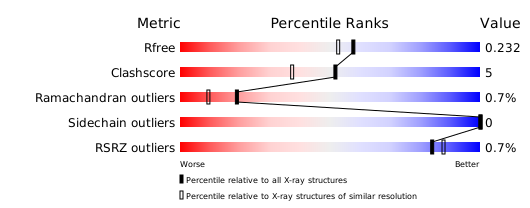
Download full validation report


