






9E8P
Crystal Structure of GABARAP-ATG3 conjugate
Summary for 9E8P
| Entry DOI | 10.2210/pdb9e8p/pdb |
| Descriptor | Ubiquitin-like-conjugating enzyme ATG3, Gamma-aminobutyric acid receptor-associated protein, SULFATE ION, ... (5 entities in total) |
| Functional Keywords | autophagy, e2, lipidation, ubiquitin-like protein, ligase |
| Biological source | Homo sapiens (human) More |
| Total number of polymer chains | 4 |
| Total formula weight | 80275.36 |
| Authors | Ohashi, K.,Otomo, T. (deposition date: 2024-11-05, release date: 2025-08-06, Last modification date: 2025-08-20) |
| Primary citation | Ohashi, K.,Kroon, G.J.,Otomo, T. Structural Insights into the GABARAP-ATG3 Backside Interaction and Apo ATG3 Conformation. Biochemistry, 64:3178-3189, 2025 Cited by PubMed Abstract: Members of the ATG8 family of ubiquitin-like proteins (Ubls) are covalently attached to phosphatidylethanolamine (PE) on nascent autophagosomal membranes, where they recruit cargo receptors and promote membrane expansion. Although the overall lipidation pathway is well established, the molecular details-particularly those involving the E2 enzyme ATG3-remain incompletely defined. Here, we uncover a previously unrecognized, noncovalent binding mode between the mammalian ATG8 protein GABARAP and the backside of ATG3's catalytic E2 domain. In crystals, an isopeptide-linked GABARAP∼ATG3 conjugate self-assembles into a helical filament via this backside interface, mirroring architectures observed for canonical Ub/Ubl∼E2 conjugates. The E2 backside-binding surface on GABARAP is topologically distinct from those of other Ub/Ubl proteins and overlaps the LC3-interacting region (LIR) motif-binding site. Solution NMR confirms this interaction, and targeted mutagenesis shows that disrupting the interface impairs PE conjugation. Complementary NMR and AlphaFold modeling of apo ATG3 reveal an intramolecular contact between a segment of its flexible region (FR) and the catalytic core that suppresses conjugation. Together, these findings establish backside engagement as a critical feature of ATG8 lipidation and illuminate the dynamic architecture and regulation of ATG3. PubMed: 40628661DOI: 10.1021/acs.biochem.4c00485 PDB entries with the same primary citation |
| Experimental method | X-RAY DIFFRACTION (2.7 Å) |
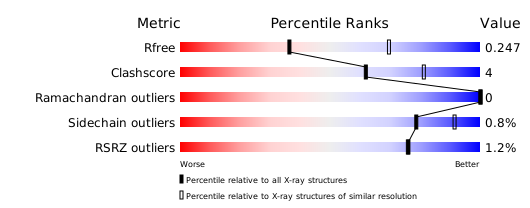
Structure validation
Download full validation report


