






 9E82
9E82
ACKR3 phosphorylated by GRK5 in complex with arrestin2 and Fab7
Summary for 9E82
| Entry DOI | 10.2210/pdb9e82/pdb |
| EMDB information | 41288 41289 41290 41291 41292 41295 41296 43277 47700 |
| Descriptor | Beta-arrestin-1, SDF-1-beta(3-72), Fab7 heavy chain, ... (6 entities in total) |
| Functional Keywords | complex, gpcr, arrestin, signaling, signaling protein-immune system complex, signaling protein/immune system |
| Biological source | Bos taurus (domestic cattle) More |
| Total number of polymer chains | 5 |
| Total formula weight | 150179.94 |
| Authors | Chen, Q.,Fuller, J.,Tesmer, J.J.G. (deposition date: 2024-11-04, release date: 2025-04-02, Last modification date: 2025-10-15) |
| Primary citation | Chen, Q.,Schafer, C.T.,Mukherjee, S.,Wang, K.,Gustavsson, M.,Fuller, J.R.,Tepper, K.,Lamme, T.D.,Aydin, Y.,Agrawal, P.,Terashi, G.,Yao, X.Q.,Kihara, D.,Kossiakoff, A.A.,Handel, T.M.,Tesmer, J.J.G. Effect of phosphorylation barcodes on arrestin binding to a chemokine receptor. Nature, 643:280-287, 2025 Cited by PubMed Abstract: Unique phosphorylation 'barcodes' installed in different regions of an active seven-transmembrane receptor by different G-protein-coupled receptor (GPCR) kinases (GRKs) have been proposed to promote distinct cellular outcomes, but it is unclear whether or how arrestins differentially engage these barcodes. Here, to address this, we developed an antigen-binding fragment (Fab7) that recognizes both active arrestin2 (β-arrestin1) and arrestin3 (β-arrestin2) without interacting with bound receptor polypeptides. We used Fab7 to determine the structures of both arrestins in complex with atypical chemokine receptor 3 (ACKR3) phosphorylated in different regions of its C-terminal tail by either GRK2 or GRK5 (ref. ). The GRK2-phosphorylated ACKR3 resulted in more heterogeneous 'tail-mode' assemblies, whereas phosphorylation by GRK5 resulted in more rigid 'ACKR3-adjacent' assemblies. Unexpectedly, the finger loops of both arrestins engaged the micelle surface rather than the receptor intracellular pocket, with arrestin3 being more dynamic, partly because of its lack of a membrane-anchoring motif. Thus, both the region of the barcode and the arrestin isoform involved can alter the structure and dynamics of GPCR-arrestin complexes, providing a possible mechanistic basis for unique downstream cellular effects, such as the efficiency of chemokine scavenging and the robustness of arrestin binding in ACKR3. PubMed: 40399676DOI: 10.1038/s41586-025-09024-9 PDB entries with the same primary citation |
| Experimental method | ELECTRON MICROSCOPY (3.4 Å) |
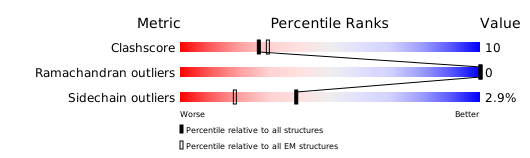
Structure validation
Download full validation report


