






 9E7Q
9E7Q
Structure of a coiled-coil peptide from C. elegans EDC4
Summary for 9E7Q
| Entry DOI | 10.2210/pdb9e7q/pdb |
| Descriptor | FHA domain-containing protein, SULFATE ION (3 entities in total) |
| Functional Keywords | mrna decapping, mrna decay, gene expression, granules, gene regulation |
| Biological source | Caenorhabditis elegans |
| Total number of polymer chains | 2 |
| Total formula weight | 7448.21 |
| Authors | Valkov, E. (deposition date: 2024-11-04, release date: 2025-11-12, Last modification date: 2026-05-06) |
| Primary citation | Simko, E.A.J.,Muthukumar, S.,Myers, T.M.,Valkov, A.L.,Valkov, E. Conserved and divergent features of human mRNA decapping revealed by biochemical reconstitution. Nat Commun, 17:-, 2026 Cited by PubMed Abstract: Decapping is a critical step in mRNA decay, but the mechanisms regulating human decapping enzyme DCP2 remain poorly understood. Here, we reconstitute the human decapping network using full-length recombinant proteins and compare it to the yeast system. Unlike in yeast, we find that the C-terminal region of human DCP2 is not autoinhibitory. RNA-binding residues of yeast Dcp2 are not conserved in the human homolog, and we find instead that a charged C-terminal region mediates substrate recognition. Human DCP1 does not stably interact with or directly stimulate DCP2, but mediates activation by the enhancer PNRC2. We also demonstrate that decapping enhancer EDC4 forms tetramers through an extended coiled-coil region, and that both DCP1 and EDC4 homomeric species can further assemble into higher-order oligomers. Furthermore, structural predictions incorporating these findings suggest a model for DCP2 recruitment by EDC4 tetramers. These findings reveal key mechanistic differences between human and yeast decapping regulation and provide insight into the molecular architecture underlying mRNA decay. PubMed: 42014425DOI: 10.1038/s41467-026-72177-2 PDB entries with the same primary citation |
| Experimental method | X-RAY DIFFRACTION (1.42 Å) |
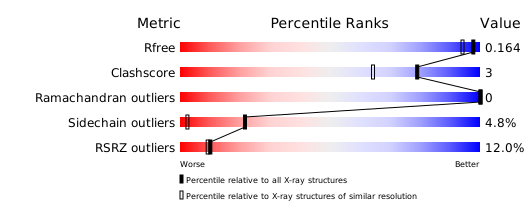
Structure validation
Download full validation report


