






 9E3G
9E3G
Torpedo muscle-type nicotinic acetylcholine receptor - Monoliganded State
Summary for 9E3G
| Entry DOI | 10.2210/pdb9e3g/pdb |
| EMDB information | 47482 |
| Descriptor | Acetylcholine receptor subunit alpha, ACETYLCHOLINE, (2S)-3-(hexadecanoyloxy)-2-[(9Z)-octadec-9-enoyloxy]propyl 2-(trimethylammonio)ethyl phosphate, ... (11 entities in total) |
| Functional Keywords | nicotinic acetylcholine receptor, ion channel, cys-loop receptor, pentameric ligand-gated ion channel, neurotransmitter-gated receptor, ligand-gated ion channel, primed state, membrane protein |
| Biological source | Tetronarce californica (Pacific electric ray) More |
| Total number of polymer chains | 5 |
| Total formula weight | 278547.02 |
| Authors | Thompson, M.J.,Nury, H.,Zarkadas, E.,Baenziger, J.E. (deposition date: 2024-10-23, release date: 2025-10-08, Last modification date: 2026-01-14) |
| Primary citation | Thompson, M.J.,Tessier, C.J.G.,Ananchenko, A.,Henault, C.,Emlaw, J.R.,Dehez, F.,Zarkadas, E.,daCosta, C.J.B.,Nury, H.,Baenziger, J.E. Asynchronous subunit transitions prime acetylcholine receptor activation. Science, 391:eadw1264-eadw1264, 2026 Cited by PubMed Abstract: Communication at synapses is facilitated by postsynaptic receptors, which convert a chemical signal into an electrical response. For ligand-gated ion channels, agonist binding triggers rapid transitions through intermediate states leading to a transient open-pore conformation, with these transitions shaping the post-synaptic response. Here, we determine structures of the muscle-type nicotinic acetylcholine receptor in unliganded, mono-liganded, and di-liganded states. Agonist binding to a single site stabilizes a closed structure where an entire principal agonist-binding subunit transitions to an active-like conformation, while the other unoccupied principal subunit remains inactive, albeit poised for activation. Uniting this intermediate structure with single-channel recordings informs a sequential activation mechanism where asynchronous subunit transitions prime the receptor for activation, a finding with implications for an entire superfamily of pentameric ligand-gated ion channels. PubMed: 41037590DOI: 10.1126/science.adw1264 PDB entries with the same primary citation |
| Experimental method | ELECTRON MICROSCOPY (3.13 Å) |
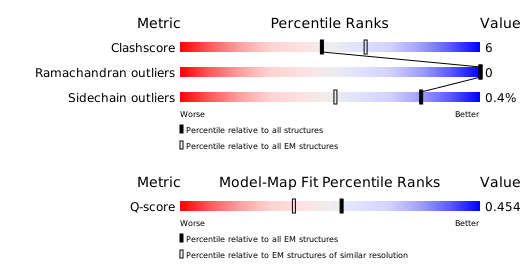
Structure validation
Download full validation report


