






 9DYF
9DYF
Asenapine-bound serotonin 1A (5-HT1A) receptor-Gi1 protein complex
This is a non-PDB format compatible entry.
Summary for 9DYF
| Entry DOI | 10.2210/pdb9dyf/pdb |
| EMDB information | 47302 |
| Descriptor | Guanine nucleotide-binding protein G(i) subunit alpha-1, Guanine nucleotide-binding protein G(I)/G(S)/G(T) subunit beta-1, Guanine nucleotide-binding protein G(I)/G(S)/G(O) subunit gamma-2, ... (7 entities in total) |
| Functional Keywords | gpcr signaling complex, serotonin receptor, signaling protein |
| Biological source | Homo sapiens (human) More |
| Total number of polymer chains | 4 |
| Total formula weight | 151369.83 |
| Authors | |
| Primary citation | Warren, A.L.,Zilberg, G.,Abbassi, A.,Abraham, A.,Yang, S.,Wacker, D. Structural determinants of G protein subtype selectivity at the serotonin receptor 5-HT1A. Sci Adv, 11:eadu9851-eadu9851, 2025 Cited by PubMed Abstract: Activation of the serotonin receptor 5-HT1A has been shown to regulate mood and cognition, making 5-HT1A an important target in the treatment of anxiety, depression, and psychosis. Although the receptor signals through inhibitory G proteins, more work is necessary to understand differences in transducer coupling and its relation to functional activity. To develop a molecular understanding of the differences underlying transducer coupling and activation, we performed structure-activity relationship studies of 5-HT1A with distinct G proteins. Through a combination of in vitro assays, we identified a potent partial agonist that selectively engages a G protein subtype. We further investigated the differences in G protein engagement at 5-HT1A with cryo-electron microscopy, determining structures of 5-HT1A bound to distinct ligands and G protein subtypes. Combined with subsequent structure-guided mutagenesis and signaling assays, our studies uncover both orthosteric and allosteric determinants of agonist-specific stimulation of distinct transducers. PubMed: 40749070DOI: 10.1126/sciadv.adu9851 PDB entries with the same primary citation |
| Experimental method | ELECTRON MICROSCOPY (2.74 Å) |
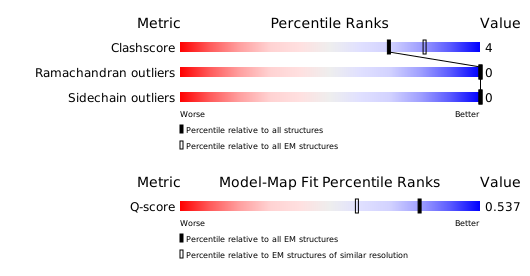
Structure validation
Download full validation report


