






 9DWQ
9DWQ
PKD2 ion channel, F629S variant
Summary for 9DWQ
| Entry DOI | 10.2210/pdb9dwq/pdb |
| EMDB information | 47260 |
| Descriptor | Polycystin-2, CALCIUM ION (2 entities in total) |
| Functional Keywords | ion channel, trp channel, polycystin, membrane protein |
| Biological source | Homo sapiens (human) |
| Total number of polymer chains | 4 |
| Total formula weight | 340213.45 |
| Authors | Esarte Palomero, O.,DeCaen, P.G. (deposition date: 2024-10-09, release date: 2025-03-12, Last modification date: 2025-09-03) |
| Primary citation | Palomero, O.E.,Guadarrama, E.,DeCaen, P.G. Pathogenic variants in the polycystin pore helix cause distinct forms of channel dysfunction. Proc.Natl.Acad.Sci.USA, 122:e2421362122-e2421362122, 2025 Cited by PubMed Abstract: PKD2 is a member of the polycystin subfamily of transient receptor potential (TRP) ion channel subunits which traffic and function in primary cilia organelle membranes. Millions of individuals carry pathogenic genetic variants in PKD2 that cause a life-threatening condition called autosomal dominant polycystic kidney disease (ADPKD). Although ADPKD is a common monogenetic disorder, there is no drug cure or available therapeutics which address the underlying channel dysregulation. Furthermore, the structural and mechanistic impacts of most disease-causing variants are uncharacterized. Using direct cilia electrophysiology, cryogenic electron microscopy (cryo-EM), and superresolution imaging, we have found mechanistic differences in channel dysregulation caused by three germline missense variants located in PKD2's pore helix 1. Variant C632R reduces protein thermal stability, resulting in impaired channel assembly and abolishes primary cilia trafficking. In contrast, variants F629S and R638C retain native cilia trafficking but exhibit gating defects. Cryo-EM structures (2.7 to 2.8 Å resolution) indicate loss of critical pore helix interactions which precipitate allosteric collapse of the channels inner gate. Results demonstrate how ADPKD-causing mutations cause mechanistically divergent and ranging impacts on PKD2 function, despite their shared structural proximity. These unexpected findings highlight the need for structural and biophysical characterization of polycystin variants, which will guide rational drug development of ADPKD therapeutics. PubMed: 40504156DOI: 10.1073/pnas.2421362122 PDB entries with the same primary citation |
| Experimental method | ELECTRON MICROSCOPY (2.76 Å) |
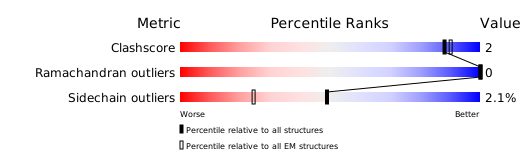
Structure validation
Download full validation report


