






 9DSB
9DSB
Crystal Structure of Spermin/spermidine N-Acetyltransferase from Enterococcus faecalis V583
Summary for 9DSB
| Entry DOI | 10.2210/pdb9dsb/pdb |
| Descriptor | Spermine/spermidine acetyltransferase, ACETATE ION, CHLORIDE ION, ... (6 entities in total) |
| Functional Keywords | gcn5-related n-acetyltransferase (gnat), polyamine acetyltransferase, structural genomics, center for structural biology of infectious diseases, csbid, transferase |
| Biological source | Enterococcus faecalis V583 |
| Total number of polymer chains | 2 |
| Total formula weight | 35928.61 |
| Authors | Kim, Y.,Maltseva, N.,Endres, M.,Kuhn, M.,Joachimiak, A.,Center for Structural Biology of Infectious Diseases (CSBID) (deposition date: 2024-09-26, release date: 2025-05-28, Last modification date: 2026-03-25) |
| Primary citation | Mayer-Harnisch, C.E.,Figueroa Paniagua, D.,Maltseva, N.,Kim, Y.,Le, V.T.B.,Joachimiak, A.,Kuhn, M.L. N-terminal domain swapping: A new paradigm for spermidine/spermine N-acetyltransferase (SSAT) protein structures? Biochem.Biophys.Res.Commun., 748:151302-151302, 2025 Cited by PubMed Abstract: Enterococcus faecalis is a multi-drug-resistant human pathogen that is found in a variety of environments and is challenging to treat. Under stress conditions, some bacteria regulate intracellular polyamine concentrations via polyamine acetyltransferases to reduce their toxicity. The E. faecalis genome encodes two polyamine acetyltransferases: PmvE and BltD. Both of these proteins belong to the Gcn5-related N-acetyltransferase (GNAT) superfamily. It is unclear why there are two enzymes with similar substrate specificities in this organism. To better understand the structure/function relationship of the E. faecalis BltD enzyme, we determined its crystal structure and performed additional assays to explore its oligomeric state and enzymatic activity. The goal was to determine whether there were structural or catalytic differences between this enzyme and other polyamine acetyltransferases that could explain this redundancy and be exploited for future development of targeted inhibitors for this important human pathogen. We found the BltD enzyme was structurally unique due to its N-terminal domain swapped dimer. However, this enzyme adopts a catalytically active monomer rather than dimer in solution. This indicates the crystal structure we obtained may represent a state that forms at high protein and salt concentrations and at low pH used during crystallization. The BltD dimer found in the crystal may represent a unique view of how an inhibitory peptide or molecule could be designed to occupy its active site. Additionally, this structure shows the extensive flexibility of the N-terminal portion of the E. faecalis BltD enzyme. PubMed: 39823891DOI: 10.1016/j.bbrc.2025.151302 PDB entries with the same primary citation |
| Experimental method | X-RAY DIFFRACTION (1.5 Å) |
Structure validation
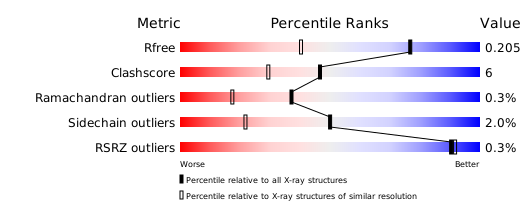
Download full validation report


