






 9DRY
9DRY
CHIP U-box dimer bound to Fab 2F1
Summary for 9DRY
| Entry DOI | 10.2210/pdb9dry/pdb |
| EMDB information | 47134 |
| Descriptor | E3 ubiquitin-protein ligase CHIP, 2F1 Fab heavy chain, 2F1 Fab light chain (3 entities in total) |
| Functional Keywords | e3 ubiquitin ligase, fab, epitope, ubiquitination inhibition, ligase, ligase-immune system complex, ligase/immune system |
| Biological source | Homo sapiens (human) More |
| Total number of polymer chains | 6 |
| Total formula weight | 109977.04 |
| Authors | |
| Primary citation | Chung, D.H.,Connelly, E.J.,Unnikrishnan, A.,Chuo, S.W.,Wucherer, K.,Nadel, C.M.,Gestwicki, J.E.,Southworth, D.R.,Craik, C.S. Recombinant antibodies inhibit enzymatic activity of the E3 ubiquitin ligase CHIP via multiple mechanisms. J.Biol.Chem., 301:108220-108220, 2025 Cited by PubMed Abstract: Carboxyl-terminus of Hsp70-Interacting Protein (CHIP) is an E3 ubiquitin ligase that marks misfolded substrates for degradation. Hyper-activation of CHIP has been implicated in multiple diseases, including cystic fibrosis and cancer, suggesting that it may be a potential drug target. However, there are few tools available for exploring this possibility. Moreover, the best ways of inhibiting CHIP's function are not obvious, as this complex protein is composed of a tetratricopeptide repeat (TPR) domain, a U-box domain, and a coiled-coil domain that mediates homodimerization. To probe the structure and function of CHIP, we report an antibody panning campaign that yielded six recombinant Fabs with affinity for CHIP. Interestingly, these antibodies varied in their binding site(s) and impact on CHIP function, such as inhibiting TPR interactions, autoubiquitination, and/or substrate ubiquitination. Of particular interest, antibody 2F1 nearly eliminated substrate binding (IC = 2.7 μM) and limited ubiquitination and autoubiquitination. Cryo-electron microscopy of the 2F1:CHIP complex revealed a 2:1 binding mode (Fab:CHIP dimer), with 2F1 bound to the U-box domain and simultaneously displacing the TPR domain. Together, these studies provide insight into ways of inhibiting CHIP's activity and provide a series of new probes for exploring the function of this important E3 ubiquitin ligase. PubMed: 39863102DOI: 10.1016/j.jbc.2025.108220 PDB entries with the same primary citation |
| Experimental method | ELECTRON MICROSCOPY (7.02 Å) |
Structure validation
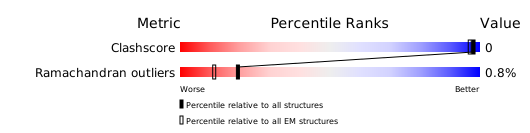
Download full validation report


