






 9DRO
9DRO
FphE, Staphylococcus aureus fluorophosphonate-binding serine hydrolases E, Oxadiazolone-peptide bound
This is a non-PDB format compatible entry.
Summary for 9DRO
| Entry DOI | 10.2210/pdb9dro/pdb |
| Descriptor | Uncharacterized hydrolase SAUSA300_2518, methyl 2-formyl-2-phenylhydrazine-1-carboxylate, MAGNESIUM ION, ... (4 entities in total) |
| Functional Keywords | fphe, staphylococcus aureus, s. aureus, fluorophosphonate-binding, serine hydrolases, lipase, hydrolase, oxadiazolone |
| Biological source | Staphylococcus aureus subsp. aureus USA300 |
| Total number of polymer chains | 2 |
| Total formula weight | 63035.79 |
| Authors | Fellner, M. (deposition date: 2024-09-25, release date: 2025-03-12, Last modification date: 2025-03-26) |
| Primary citation | Wang, S.,Woods, E.C.,Jo, J.,Zhu, J.,Hansel-Harris, A.,Holcomb, M.,Llanos, M.,Pedowitz, N.J.,Upadhyay, T.,Bennett, J.,Fellner, M.,Park, K.W.,Zhang, A.,Valdez, T.A.,Forli, S.,Chan, A.I.,Cunningham, C.N.,Bogyo, M. An mRNA Display Approach for Covalent Targeting of a Staphylococcus aureus Virulence Factor. J.Am.Chem.Soc., 147:8312-8325, 2025 Cited by PubMed Abstract: () is an opportunistic human pathogen that causes over one million deaths around the world each year. We recently identified a family of serine hydrolases termed fluorophosphonate binding hydrolases (Fphs) that play important roles in lipid metabolism and colonization of a host. Because many of these enzymes are only expressed in bacteria, they are valuable targets for diagnostics and therapeutics. Here, we developed and screened highly diverse cyclic peptide libraries using mRNA display with a genetically encoded oxadiazolone (Ox) electrophile that was previously shown to potently and covalently inhibit multiple Fph enzymes. By performing multiple rounds of counter selections with WT and catalytic dead FphB, we were able to tune the selectivity of the resulting selected cyclic peptides containing the Ox residue toward the active site serine. From our mRNA display hits, we developed potent and selective fluorescent probes that label the active site of FphB at single digit nanomolar concentrations in live bacteria. Taken together, this work demonstrates the potential of using direct genetically encoded electrophiles for mRNA display of covalent binding ligands and identifies potent new probes for FphB that have the potential to be used for diagnostic and therapeutic applications. PubMed: 40013487DOI: 10.1021/jacs.4c15713 PDB entries with the same primary citation |
| Experimental method | X-RAY DIFFRACTION (1.54 Å) |
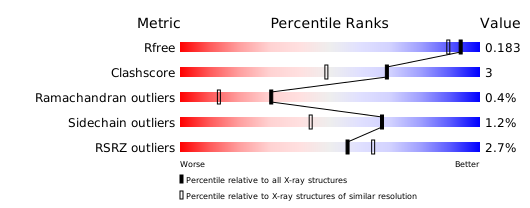
Structure validation
Download full validation report


