






 9DOU
9DOU
Taeniopygia guttata R2 retrotransposon (R2Tg) initiating target-primed reverse transcription
Summary for 9DOU
| Entry DOI | 10.2210/pdb9dou/pdb |
| EMDB information | 47091 |
| Descriptor | R2Tg retrotransposon ORF, 28S DNA bottom strand, 3' side, 28S DNA bottom strand, 5' side (priming strand), ... (8 entities in total) |
| Functional Keywords | retrotransposon, line, reverse transcriptase, endonuclease, rna binding protein-rna-dna complex, rna binding protein/rna/dna |
| Biological source | Taeniopygia guttata (zebra finch) More |
| Total number of polymer chains | 5 |
| Total formula weight | 398927.59 |
| Authors | Wilkinson, M.E.,Edmonds, K.H.K.,Zhang, F. (deposition date: 2024-09-19, release date: 2025-05-21, Last modification date: 2025-07-16) |
| Primary citation | Edmonds, K.K.,Wilkinson, M.E.,Strebinger, D.,Chen, H.,Lash, B.,Schaefer, C.C.,Zhu, S.,Liu, D.,Zilberzwige-Tal, S.,Ladha, A.,Walsh, M.L.,Frangieh, C.J.,Vaz Reay, N.A.,Macrae, R.K.,Wang, X.,Zhang, F. Structure and biochemistry-guided engineering of an all-RNA system for DNA insertion with R2 retrotransposons. Nat Commun, 16:6079-6079, 2025 Cited by PubMed Abstract: R2 elements, a class of non-long terminal repeat (non-LTR) retrotransposons, have the potential to be harnessed for transgene insertion. However, efforts to achieve this are limited by our understanding of the retrotransposon mechanisms. Here, we structurally and biochemically characterize R2 from Taeniopygia guttata (R2Tg). We show that R2Tg cleaves both strands of its ribosomal DNA target and binds a pseudoknotted RNA element within the R2 3' UTR to initiate target-primed reverse transcription. Guided by these insights, we engineer and characterize an all-RNA system for transgene insertion. We substantially reduce the system's size and insertion scars by eliminating unnecessary R2 sequences on the donor. We further improve the integration efficiency by chemically modifying the 5' end of the donor RNA and optimizing delivery, creating a compact system that achieves over 80% integration efficiency in several human cell lines. This work expands the genome engineering toolbox and provides mechanistic insights that will facilitate future development of R2-mediated gene insertion tools. PubMed: 40603868DOI: 10.1038/s41467-025-61321-z PDB entries with the same primary citation |
| Experimental method | ELECTRON MICROSCOPY (3.2 Å) |
Structure validation
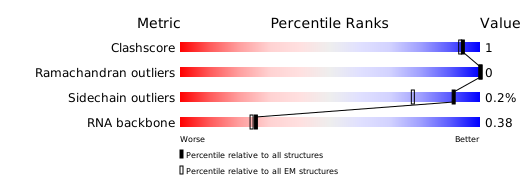
Download full validation report


