






 9DNH
9DNH
RamR variant D2.3 complexed with 1-phenyl-dihydroisoquinoline
This is a non-PDB format compatible entry.
Summary for 9DNH
| Entry DOI | 10.2210/pdb9dnh/pdb |
| Related | 9DN8 9DN9 9DNC |
| Descriptor | Engineered RamR variant D2.3, 1-phenyl-3,4-dihydroisoquinoline (3 entities in total) |
| Functional Keywords | directed evolution, transcription factor, stereoselectivity, transcription |
| Biological source | Salmonella enterica subsp. enterica serovar Typhimurium |
| Total number of polymer chains | 2 |
| Total formula weight | 43898.91 |
| Authors | Kim, W.,Zhang, Y.J. (deposition date: 2024-09-17, release date: 2026-04-08, Last modification date: 2026-08-05) |
| Primary citation | d'Oelsnitz, S.,Kim, W.,Zhao, N.N.,Hardtke, H.,Ikonomova, S.P.,Alperovich, N.,Vasilyeva, O.,James, M.J.,Zigon, E.S.,Cory, M.B.,Johnson, C.D.,Ellington, A.D.,Justman, Q.A.,Springer, M.,Zhang, Y.J.,Silver, P.A.,Ross, D. Using enantioselective biosensors to evolve asymmetric biocatalysts. Nat.Chem.Biol., 2026 Cited by PubMed Abstract: Biocatalysts are prized for their enantioselectivity, but slow chromatographic separations required to measure enantiomeric excess bottleneck their development. To overcome this limitation, we evolve enantioselective transcription factors (eTFs) that convert enzyme-catalyzed enantiomer concentrations into programmable gene expression outputs, focusing on imine reductases. Here, using a massively parallel reporter assay, we measure dose-response curves for over 300,000 transcription factor variants in response to an imine precursor and chiral amine products. We quantify the sensitivity, selectivity and dynamic range across variants generated by random, site-saturation and shuffling mutagenesis, isolating variants with exceptional specificity. High-resolution structures of evolved eTFs elucidate how steric effects enforce enantioselectivity, while charge interactions distinguish the imine from the amines. Using two eTFs, we create an ultrahigh-throughput chiral screen to evolve an imine reductase with inverted enantioselectivity. To support generalizability and speed, we design a genetic circuit that enables TF generation within weeks. Our methods enable rapid measurement of asymmetric reactions, supporting innovation in chemical manufacturing. PubMed: 42493606DOI: 10.1038/s41589-026-02275-1 PDB entries with the same primary citation |
| Experimental method | X-RAY DIFFRACTION (2.37 Å) |
Structure validation
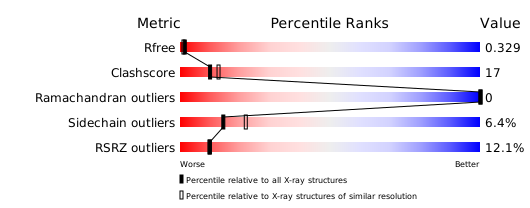
Download full validation report


