






 9DML
9DMLSummary for 9DML
| Entry DOI | 10.2210/pdb9dml/pdb |
| EMDB information | 47009 |
| Descriptor | Fab2 heavy chain, (2S)-3-(hexadecanoyloxy)-2-[(9Z)-octadec-9-enoyloxy]propyl 2-(trimethylammonio)ethyl phosphate, CHOLESTEROL, ... (11 entities in total) |
| Functional Keywords | human muscle, nicotinic acetylcholine receptor, membrane protein |
| Biological source | Homo sapiens (human) More |
| Total number of polymer chains | 9 |
| Total formula weight | 392273.32 |
| Authors | Li, H.,Hibbs, R.E. (deposition date: 2024-09-13, release date: 2025-04-09, Last modification date: 2025-10-22) |
| Primary citation | Li, H.,Pham, M.C.,Teng, J.,O'Connor, K.C.,Noviello, C.M.,Hibbs, R.E. Autoimmune mechanisms elucidated through muscle acetylcholine receptor structures. Cell, 188:2390-2406.e20, 2025 Cited by PubMed Abstract: Skeletal muscle contraction is triggered by acetylcholine (ACh) binding to its ionotropic receptors (AChRs) at neuromuscular junctions. In myasthenia gravis (MG), autoantibodies target AChRs, disrupting neurotransmission and causing muscle weakness. While treatments exist, variable patient responses suggest pathogenic heterogeneity. Progress in understanding the molecular basis of MG has been limited by the absence of structures of intact human muscle AChRs. Here, we present high-resolution cryoelectron microscopy (cryo-EM) structures of the human adult AChR in different functional states. Using six MG patient-derived monoclonal antibodies, we mapped distinct epitopes involved in diverse pathogenic mechanisms, including receptor blockade, internalization, and complement activation. Electrophysiological and binding assays revealed how these autoantibodies directly inhibit AChR channel activation. These findings provide critical insights into MG immunopathogenesis, uncovering unrecognized antibody epitope diversity and modes of receptor inhibition, and provide a framework for developing personalized therapies targeting antibody-mediated autoimmune disorders. PubMed: 40203823DOI: 10.1016/j.cell.2025.03.004 PDB entries with the same primary citation |
| Experimental method | ELECTRON MICROSCOPY (2.24 Å) |
Structure validation
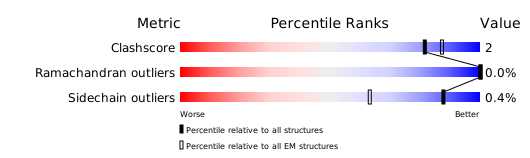
Download full validation report


