






9DKW
Human mitochondrial ClpP in complex with Bortezomib
9DKW の概要
| エントリーDOI | 10.2210/pdb9dkw/pdb |
| 関連するPDBエントリー | 9DKV |
| EMDBエントリー | 46970 46971 |
| 分子名称 | ATP-dependent Clp protease proteolytic subunit, mitochondrial, N-[(1R)-1-(DIHYDROXYBORYL)-3-METHYLBUTYL]-N-(PYRAZIN-2-YLCARBONYL)-L-PHENYLALANINAMIDE (3 entities in total) |
| 機能のキーワード | protease, proteolysis, hydrolase |
| 由来する生物種 | Homo sapiens (human) |
| タンパク質・核酸の鎖数 | 14 |
| 化学式量合計 | 343897.57 |
| 構造登録者 | Uday, A.B.,Zeytuni, N.,Goncalves, M.,Vahidi, S. (登録日: 2024-09-10, 公開日: 2025-04-23, 最終更新日: 2025-04-30) |
| 主引用文献 | Goncalves, M.M.,Uday, A.B.,Forrester, T.J.B.,Currie, S.Q.W.,Kim, A.S.,Feng, Y.,Jitkova, Y.,Velyvis, A.,Harkness, R.W.,Kimber, M.S.,Schimmer, A.D.,Zeytuni, N.,Vahidi, S. Mechanism of allosteric activation in human mitochondrial ClpP protease. Proc.Natl.Acad.Sci.USA, 122:e2419881122-e2419881122, 2025 Cited by PubMed Abstract: Human ClpP protease contributes to mitochondrial protein quality control by degrading misfolded proteins. ClpP is overexpressed in cancers such as acute myeloid leukemia (AML), where its inhibition leads to the accumulation of damaged respiratory chain subunits and cell death. Conversely, hyperactivating ClpP with small-molecule activators, such as the recently discovered ONC201, disrupts mitochondrial protein degradation and impairs respiration in cancer cells. Despite its critical role in human health, the mechanism underlying the structural and functional properties of human ClpP remains elusive. Notably, human ClpP is paradoxically activated by active-site inhibitors. All available structures of human ClpP published to date are in the inactive compact or compressed states, surprisingly even when ClpP is bound to an activator molecule such as ONC201. Here, we present structures of human mitochondrial ClpP in the active extended state, including a pair of structures where ClpP is bound to an active-site inhibitor. We demonstrate that amino acid substitutions in the handle region (A192E and E196R) recreate a conserved salt bridge found in bacterial ClpP, stabilizing the extended active state and significantly enhancing ClpP activity. We elucidate the ClpP activation mechanism, highlighting a hormetic effect where substoichiometric inhibitor binding triggers an allosteric transition that drives ClpP into its active extended state. Our findings link the conformational dynamics of ClpP to its catalytic function and provide high-resolution structures for the rational design of potent and specific ClpP inhibitors, with implications for targeting AML and other disorders with ClpP involvement. PubMed: 40232800DOI: 10.1073/pnas.2419881122 主引用文献が同じPDBエントリー |
| 実験手法 | ELECTRON MICROSCOPY (2.49 Å) |
構造検証レポート
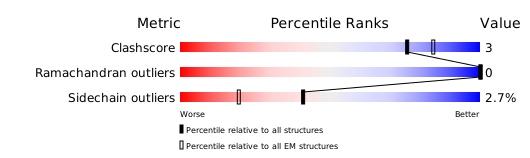
検証レポート(詳細版) をダウンロード
をダウンロード


