






 9DCJ
9DCJ
Pentameric Structure of MERS-CoV Envelope Protein Transmembrane Domain Determined by Solid-State NMR
Summary for 9DCJ
| Entry DOI | 10.2210/pdb9dcj/pdb |
| NMR Information | BMRB: 31198 |
| Descriptor | Envelope small membrane protein (1 entity in total) |
| Functional Keywords | viroporin, mers-cov, viral protein |
| Biological source | Betacoronavirus England 1 |
| Total number of polymer chains | 5 |
| Total formula weight | 21546.14 |
| Authors | |
| Primary citation | Sucec, I.,Xia, B.,Somberg, N.H.,Wang, Y.,Jo, H.,Li, S.,Perrone, B.,Gao, Z.,Hong, M. Ion channel structure and function of the MERS coronavirus E protein. Sci Adv, 11:eadx1788-eadx1788, 2025 Cited by PubMed Abstract: Coronavirus envelope (E) proteins form drug-targeted ion channels that cause virulence to infected cells. The Middle East respiratory syndrome (MERS) virus has high mortality rates, but its E structure and function are unknown. We report the single-channel conductance and structure of membrane-bound MERS E protein. MERS E conducts K ions with a unitary conductance of 113 picosiemens, fivefold larger than the conductance of severe acute respiratory syndrome coronavirus 2 E. Solid-state nuclear magnetic resonance data indicate that the MERS E transmembrane domain forms a five-helix bundle that spans the lipid bilayer. The amino-terminal helical interface features multiple interacting phenylalanine (Phe) residues and an asparagine (Asn), whereas the carboxyl-terminal channel pore contains Phe. Mutation of Phe abolished K conductance, whereas mutations of Phe and Asn suppressed most channel activity. These results indicate that MERS E contains two Phe-centered ion-conduction apparatuses, which likely permeate ions through cation-π interactions, providing the structural basis for developing antiviral drugs to inhibit this pathogenic viroporin. PubMed: 40632851DOI: 10.1126/sciadv.adx1788 PDB entries with the same primary citation |
| Experimental method | SOLID-STATE NMR |
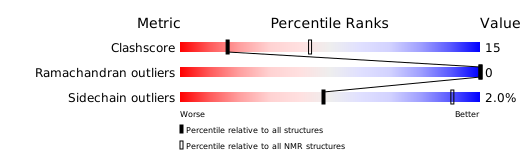
Structure validation
Download full validation report


