






 9D57
9D57
iGABASnFR2 fluorescent GABA sensor in complex with GABA
Summary for 9D57
| Entry DOI | 10.2210/pdb9d57/pdb |
| Descriptor | ABC transporter substrate-binding protein, Circular permuted superfolder GFP fusion, GAMMA-AMINO-BUTANOIC ACID (3 entities in total) |
| Functional Keywords | genetically encoded gaba sensor, fluorescent sensor, fluorescent protein |
| Biological source | synthetic construct |
| Total number of polymer chains | 6 |
| Total formula weight | 375500.20 |
| Authors | Zhang, Y.,Looger, L.L. (deposition date: 2024-08-13, release date: 2025-08-20, Last modification date: 2026-04-08) |
| Primary citation | Kolb, I.,Hasseman, J.P.,Matsumoto, A.,Jensen, T.P.,Kopach, O.,Arthur, B.J.,Zhang, Y.,Tsang, A.,Reep, D.,Tsegaye, G.,Zheng, J.,Patel, R.H.,Looger, L.L.,Marvin, J.S.,Korff, W.L.,Rusakov, D.A.,Yonehara, K.,Turner, G.C. iGABASnFR2 is an improved genetically encoded protein sensor of GABA. Elife, 14:-, 2026 Cited by PubMed Abstract: Monitoring GABAergic inhibition in the nervous system has been enabled by the development of an intensiometric molecular sensor that directly detects GABA. However, the first generation iGABASnFR exhibits low signal-to-noise and suboptimal kinetics, making in vivo experiments challenging. To improve sensor performance, we targeted several sites in the protein for near-saturation mutagenesis and evaluated the resulting sensor variants in a high-throughput screening system using evoked synaptic release in primary cultured neurons. This identified a sensor variant, iGABASnFR2, with 4.1-fold improved sensitivity and 30% faster rise time, and binding affinity that remained in a range sensitive to changes in GABA concentration at synapses. We also identified sensors with an inverted response, decreasing fluorescence intensity upon GABA binding. We termed the best such negative-going sensor iGABASnFR2n, which can be used to corroborate observations with the positive-going sensor. These improvements yielded a qualitative enhancement of in vivo performance when compared directly to the original sensor. iGABASnFR2 enabled the first measurements of direction-selective GABA release in the retina. In vivo imaging in somatosensory cortex revealed that iGABASnFR2 can report volume-transmitted GABA release following whisker stimulation. Overall, the improved sensitivity and kinetics of iGABASnFR2 make it a more effective tool for imaging GABAergic transmission in intact neural circuits. PubMed: 41848771DOI: 10.7554/eLife.108319 PDB entries with the same primary citation |
| Experimental method | X-RAY DIFFRACTION (2.6 Å) |
Structure validation
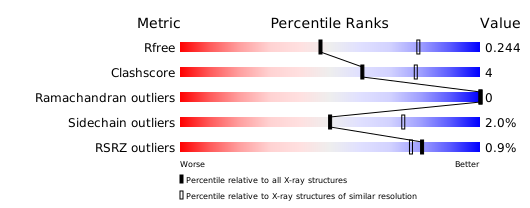
Download full validation report


