






 9D4S
9D4S
Structure of G2L4 RT in complex with 15 nucleotide snapback substrate
Summary for 9D4S
| Entry DOI | 10.2210/pdb9d4s/pdb |
| Descriptor | Group II intron-like 4 reverse transcriptase, DNA, MANGANESE (II) ION, ... (5 entities in total) |
| Functional Keywords | reverse transcriptase, microhomology-mediated end-joining, dna repair., dna binding protein |
| Biological source | Gammaproteobacteria More |
| Total number of polymer chains | 4 |
| Total formula weight | 103302.49 |
| Authors | |
| Primary citation | Park, S.K.,Guo, M.,Stamos, J.L.,Kim, W.,Lee, S.,Zhang, Y.J.,Lambowitz, A.M. Structural basis for the evolution of a domesticated group II intron-like reverse transcriptase to function in host cell DNA repair. Proc.Natl.Acad.Sci.USA, 122:e2504208122-e2504208122, 2025 Cited by PubMed Abstract: A previous study found that a bacterial group II intron-like reverse transcriptase (G2L4 RT) evolved to function in double-strand break repair (DSBR) via microhomology-mediated end-joining (MMEJ) and that a mobile group II intron-encoded RT has a basal DSBR activity that uses conserved structural features of non-long terminal repeat (non-LTR)-retroelement RTs. Here, we determined G2L4 RT apoenzyme and snap-back DNA synthesis structures revealing unique structural adaptations that optimized its cellular function in DSBR. These included an RT3a structure that stabilizes the apoenzyme in an inactive conformation until encountering a DNA substrate; a longer N-terminal extension/RT0-loop with conserved residues that together with a modified active site favors strand annealing; and a conserved dimer interface that localizes G2L4 RT homodimers to DSBR sites with both monomers positioned for MMEJ. Our findings reveal how an RT can function in DNA repair and suggest ways of optimizing related RTs for genome engineering applications. PubMed: 40729381DOI: 10.1073/pnas.2504208122 PDB entries with the same primary citation |
| Experimental method | X-RAY DIFFRACTION (2.77 Å) |
Structure validation
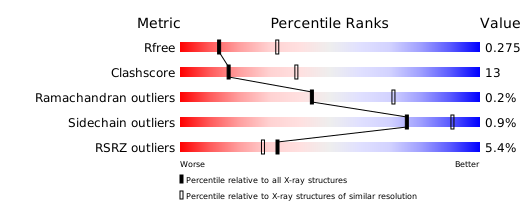
Download full validation report


