






 9D26
9D26
A widespread heme dechelatase in healthy and pathogenic human microbiomes.
Summary for 9D26
| Entry DOI | 10.2210/pdb9d26/pdb |
| EMDB information | 46483 |
| Descriptor | HmuS heme dechelatase, PROTOPORPHYRIN IX CONTAINING FE, SODIUM ION, ... (4 entities in total) |
| Functional Keywords | iron, microbiome, heme, metal transport |
| Biological source | Bacteroides |
| Total number of polymer chains | 1 |
| Total formula weight | 163085.75 |
| Authors | Gauvin, C.C.,Nath, A.K.,Rodrigues da Silva, R.,Akpoto, E.,Dubois, J.L.,Lawrence, C.M. (deposition date: 2024-08-08, release date: 2025-08-20, Last modification date: 2026-08-12) |
| Primary citation | Kumar Nath, A.,da Silva, R.R.,Gauvin, C.C.,Akpoto, E.,Dlakic, M.,Lawrence, C.M.,DuBois, J.L. Commensal gut bacteria employ de-chelatase HmuS to harvest iron from heme. Embo J., 44:6226-6252, 2025 Cited by PubMed Abstract: Iron is essential for almost all organisms, which have evolved different strategies for ensuring a sufficient supply from their environment and using it in different forms, including heme. The hmu operon, primarily found in Bacteroidota and ubiquitous in gastrointestinal tract metagenomes of healthy humans, encodes proteins involved in heme acquisition. Here, we provide direct physiological, biochemical, and structural evidence for the anaerobic removal of iron from heme by HmuS, a membrane-bound, NADH-dependent de-chelatase that deconstructs heme to protoporphyrin IX (PPIX) and Fe(II). Heme can serve as the sole iron source for the model gastrointestinal bacterium Bacteroidetes thetaiotaomicron, when active HmuS is present. Heterologously expressed HmuS was isolated with bound heme molecules under saturating conditions. Its cryo-EM structure at 2.6 Å resolution revealed binding of heme and a pair of cations at distant sites. These sites are conserved across the HmuS family and chelatase superfamily, respectively. The proposed structure-based mechanism for iron removal by HmuS is chemically analogous to the chelatases in both unrelated heme biosynthetic pathways and homologous enzymes in the biosynthetic pathways for chlorophyll and vitamin B12, although the reaction proceeds in the opposite direction. Taken together, our study identifies a widespread mechanism via which anaerobic bacteria can extract nutritional iron from heme. PubMed: 40940422DOI: 10.1038/s44318-025-00563-5 PDB entries with the same primary citation |
| Experimental method | ELECTRON MICROSCOPY (2.6 Å) |
Structure validation
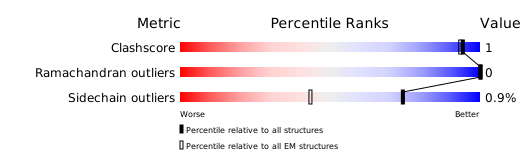
Download full validation report


