






 9CUC
9CUC9CUC の概要
| エントリーDOI | 10.2210/pdb9cuc/pdb |
| 分子名称 | Stimulator of interferon genes protein, (3S,4S)-2-(4-tert-butyl-3-chlorophenyl)-3-(2,3-dihydro-1,4-benzodioxin-6-yl)-1-oxo-1,2,3,4-tetrahydroisoquinoline-4-carboxylic acid (3 entities in total) |
| 機能のキーワード | innate immunity, membrane protein |
| 由来する生物種 | Homo sapiens (human) |
| タンパク質・核酸の鎖数 | 6 |
| 化学式量合計 | 147185.21 |
| 構造登録者 | |
| 主引用文献 | Xie, T.,Ruzanov, M.,Critton, D.,Merselis, L.,Naglich, J.,Sack, J.S.,Zhang, P.,Xie, C.,Tredup, J.,Stine, L.B.,Messier, C.,Hope, D.L.,Caceres-Cortes, J.,Mueller, L.,Dyckman, A.J.,Newitt, J.A.,Choudhury, A.,Wilson, S.C. Orthosteric STING inhibition elucidates molecular correction of SAVI STING. Nat Commun, 16:5695-5695, 2025 Cited by PubMed Abstract: While the progression of STING activators into the clinic has been successful, the discovery and clinical progression of STING inhibitors remain elusive. Questions persist about the molecular properties needed to distinguish between a STING activator and inhibitor, particularly within SAVI disease, a monogenic autoinflammatory disease that renders STING constitutively active, and how different conformations correlate to function. In this work, we use an orthosteric STING activator and inhibitor from the same chemical series to discover that STING M271 is a critical residue for molecular activation that can be leveraged as a unique molecular signature for pharmacological or genetically driven activation and inhibition. Furthermore, we demonstrate how the therapeutic requirements of a molecular corrector of SAVI STING differs from an orthosteric STING inhibitor, and why this is important for the SAVI disease population. PubMed: 40595544DOI: 10.1038/s41467-025-60632-5 主引用文献が同じPDBエントリー |
| 実験手法 | X-RAY DIFFRACTION (2.097 Å) |
構造検証レポート
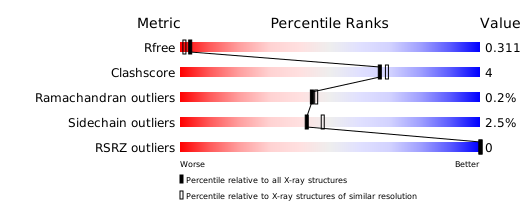
検証レポート(詳細版) をダウンロード
をダウンロード


