






 9COK
9COK
Cryo-EM structure of the Nipah virus (Malaysia Strain) L:P complex
Summary for 9COK
| Entry DOI | 10.2210/pdb9cok/pdb |
| EMDB information | 45782 |
| Descriptor | Phosphoprotein, RNA-directed RNA polymerase L (2 entities in total) |
| Functional Keywords | rna dependent rna polymerase, nipah virus, lp complex, viral protein, transferase |
| Biological source | Henipavirus nipahense More |
| Total number of polymer chains | 7 |
| Total formula weight | 764797.14 |
| Authors | Chen, Z.H.,Liang, B. (deposition date: 2024-07-16, release date: 2025-07-23, Last modification date: 2025-11-05) |
| Primary citation | Chen, Z.,Quirit Dudley, J.,Deniston, C.,Buffalo, C.Z.,Patra, D.,Cao, D.,Hunt, J.,Rohaim, A.,Sengupta, D.,Wen, L.,Tsang, T.,Xie, L.,DiDonato, M.,Spraggon, G.,Clifton, M.C.,Jarrousse, N.,Straimer, J.,Liang, B. Cryo-EM structures of Nipah virus polymerases and high-throughput RdRp assay development enable anti-NiV drug discovery. Nat Commun, 16:6655-6655, 2025 Cited by PubMed Abstract: Transcription and replication of the Nipah virus (NiV) are driven by the large protein (L) together with its essential co-factor phosphoprotein (P). L encodes all the viral enzymatic functions, including RNA-dependent RNA polymerase (RdRp) activity, while the tetrameric P is multi-modular. Here, we investigate the molecular mechanism of the NiV polymerase and build tools for anti-NiV drug discovery. We analyze and compare multiple cryo-EM structures of both full-length and truncated NiV polymerases from the Malaysia and Bangladesh strains. We identify two conserved loops in the polyribonucleotidyltransferase (PRNTase) domain of L and the binding between RdRp-PRNTase and CD domains. To further assess the mechanism of NiV polymerase activity, we establish a highly sensitive radioactive-labeled RNA synthesis assay and identify a back-priming activity in the NiV polymerase as well as a fluorescence and luminescent-based non-radioactive polymerase assay to enable high-throughput screening for L protein inhibitors. The combination of structural analysis and the development of both high-sensitive and high-throughput biochemical assays will enable the identification of new direct-acting antiviral candidates for treating highly pathogenic henipaviruses. PubMed: 40683863DOI: 10.1038/s41467-025-61764-4 PDB entries with the same primary citation |
| Experimental method | ELECTRON MICROSCOPY (2.92 Å) |
Structure validation
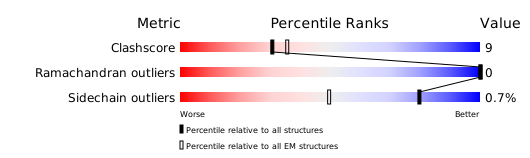
Download full validation report


