






 9CJP
9CJP
X-ray crystal structure of SARS-CoV-2 main protease quadruple mutants in complex with Nirmatrelvir
Summary for 9CJP
| Entry DOI | 10.2210/pdb9cjp/pdb |
| Descriptor | 3C-like proteinase nsp5, (1R,2S,5S)-N-{(1E,2S)-1-imino-3-[(3S)-2-oxopyrrolidin-3-yl]propan-2-yl}-6,6-dimethyl-3-[3-methyl-N-(trifluoroacetyl)-L-valyl]-3-azabicyclo[3.1.0]hexane-2-carboxamide, 1,2-ETHANEDIOL, ... (6 entities in total) |
| Functional Keywords | hydrolase-inhibitor complex, sars2, hydrolase/inhibitor |
| Biological source | Severe acute respiratory syndrome coronavirus 2 |
| Total number of polymer chains | 2 |
| Total formula weight | 69114.26 |
| Authors | Esler, M.A.,Shi, K.,Harris, R.S.,Aihara, H. (deposition date: 2024-07-07, release date: 2025-07-09, Last modification date: 2026-01-21) |
| Primary citation | Esler, M.A.,Shi, K.,Rollie, J.A.,Delgado, R.,Vishwakarma, J.,Dabrowska, A.,Prahlad, J.,Moghadasi, S.A.,Harris, R.S.,Aihara, H. Structural basis for varying drug resistance of SARS-CoV-2 M pro E166 variants. Mbio, 16:e0262424-e0262424, 2025 Cited by PubMed Abstract: Severe acute respiratory syndrome coronavirus 2 (SARS-CoV-2) main protease (M) has an essential role in the virus lifecycle and, accordingly, it is a target for antiviral drugs. Multiple studies have identified an M mutation (E166V) that confers strong resistance to clinically relevant inhibitors, including nirmatrelvir, but the underlying mechanism is not fully understood. Here, we report on crystal structures of SARS-CoV-2 M E166V in complex with nirmatrelvir, ensitrelvir, and bofutrelvir. The structures suggest that resistance is caused in part by the loss of a direct hydrogen bond and also, especially for nirmatrelvir, by a steric clash with the substituted valine residue. In comparison, the binding of bofutrelvir shows greater flexibility, which may help alleviate this steric effect and allow bofutrelvir to fit the mutant active site despite the loss of a direct polar contact. Thermal stability analyses also corroborate E166V most severely affecting the binding of nirmatrelvir and, to lesser and different extents, ensitrelvir and bofutrelvir. We further show that E166I causes even more severe nirmatrelvir resistance, whereas E166A and E166L have much milder effects. These studies shed light on the molecular mechanisms of a key M drug resistance mutation and may help inform the design of next-generation inhibitors.IMPORTANCEUsing a combination of high-resolution X-ray crystallographic and biochemical analyses, we reveal the molecular mechanisms by which a mutation in the severe acute respiratory syndrome coronavirus 2 main protease (M) confers strong resistance against clinically relevant antiviral drugs that inhibit M activity. The results presented here may help inform the design of next-generation inhibitors to combat the problem of therapy resistance. PubMed: 40454888DOI: 10.1128/mbio.02624-24 PDB entries with the same primary citation |
| Experimental method | X-RAY DIFFRACTION (1.71 Å) |
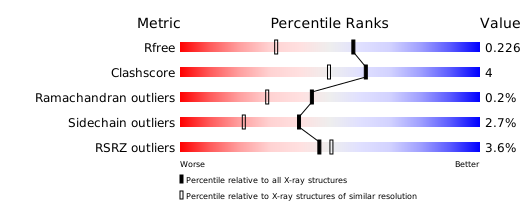
Structure validation
Download full validation report


