






 9CHT
9CHT
Human E3 ligase E6AP in complex with HPV16-E6 and p53
9CHT の概要
| エントリーDOI | 10.2210/pdb9cht/pdb |
| EMDBエントリー | 45601 |
| 分子名称 | Ubiquitin-protein ligase E3A, Immunoglobulin G-binding protein G/Cellular tumor antigen p53 fusion protein, Protein E6 (3 entities in total) |
| 機能のキーワード | complex, viral, ubiquitination, ligase |
| 由来する生物種 | Homo sapiens (human) 詳細 |
| タンパク質・核酸の鎖数 | 3 |
| 化学式量合計 | 165149.97 |
| 構造登録者 | |
| 主引用文献 | Kenny, S.,Iyer, S.,Gabel, C.A.,Tegenfeldt, N.,DeMarco, A.G.,Hall, M.C.,Chang, L.,Davisson, V.J.,Pol, S.V.,Das, C. Structure of E6AP in complex with HPV16-E6 and p53 reveals a novel ordered domain important for E3 ligase activation. Structure, 33:504-516.e4, 2025 Cited by PubMed Abstract: High-risk human papillomavirus E6 oncoprotein is a model system for the recognition and degradation of cellular p53 tumor suppressor protein. There remains a gap in the understanding of the ubiquitin transfer reaction, including placement of the E6AP catalytic HECT domain of the ligase concerning the p53 substrate and how E6 itself is protected from ubiquitination. We determined the cryoelectron microscopy (cryo-EM) structure of the E6AP/E6/p53 complex, related the structure to in vivo modeling of the tri-molecular complex, and identified structural interactions associated with activation of the ubiquitin ligase function. The structure reveals that the N-terminal ordered domain (NOD) in E6AP has a terminal alpha helix that mediates the interaction of the NOD with the HECT domain of E6AP and protects the HPV-E6 protein from ubiquitination. In addition, this NOD helix is required for E6AP ligase function by contributing to the affinity of the E6-E6AP association, modulating E6 substrate recognition, while displacing UbcH7. PubMed: 39818213DOI: 10.1016/j.str.2024.12.013 主引用文献が同じPDBエントリー |
| 実験手法 | ELECTRON MICROSCOPY (3.54 Å) |
構造検証レポート
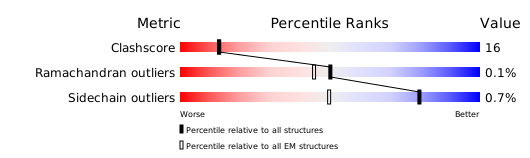
検証レポート(詳細版) をダウンロード
をダウンロード


