






 9CCR
9CCR
Crystal structure of the EspE7 thioesterase mutant R35A from the esperamicin biosynthetic pathway at 1.6 A
Summary for 9CCR
| Entry DOI | 10.2210/pdb9ccr/pdb |
| Related | 5vpj |
| Descriptor | Thioesterase, POTASSIUM ION, DODECYL-COA, ... (4 entities in total) |
| Functional Keywords | thioesterase, hot-dog, enediyne biosynthetic pathway, esperamicin biosynthesis, natural product biosynthesis, hydrolase |
| Biological source | Actinomadura verrucosospora |
| Total number of polymer chains | 4 |
| Total formula weight | 84886.96 |
| Authors | Miller, M.D.,Hankore, E.D.,Xu, W.,Kosgei, A.J.,Bhardwaj, M.,Thorson, J.S.,Van Lanen, S.G.,Phillips Jr., G.N. (deposition date: 2024-06-23, release date: 2025-06-25, Last modification date: 2025-11-05) |
| Primary citation | Hankore, E.D.,Miller, M.D.,Kosgei, A.J.,Xu, W.,Tan, K.,Endres, M.,Bhardwaj, M.,Joachimiak, G.,Joachimiak, A.,Phillips Jr., G.N.,Thorson, J.S.,Van Lanen, S.G. Functional and Structural Studies on the Esperamicin Thioesterase and Progress toward Understanding Enediyne Core Biosynthesis. J.Nat.Prod., 88:2360-2371, 2025 Cited by PubMed Abstract: Enediynes are among the most potent antitumor and antibacterial natural products. Studies on their biosynthetic pathways have identified a shared, linear polyene precursor generated from an iterative type I polyketide synthase (PKSE) as the source of the enediyne warhead. A key step is the release of this polyene from the PKSE by a discrete thioesterase (TE). Here, we used X-ray crystallography, site-directed mutagenesis, and heterologous coexpression of PKSEs and TEs to elucidate how enediyne TEs mediate the production of the polyene. We solved the structure of wild-type EspE7 from esperamicin producer . The substrate binding pocket was also defined upon serendipitous cocrystallization of an EspE7 mutant with a fatty acyl-CoA ligand. Structural data and activity assays with EspE7 mutants provide strong evidence that Glu68 in EspE7 and the analogous Glu residue in other enediyne TEs functions as a key catalytic residue, thus supporting a hydrolysis mechanism for enediyne TEs that aligns with that of sp. 4-HB-CoA TE. Furthermore, combinations of 9- and 10-membered enediyne PKSEs and TEs produced 1,3,5,7,9,11,13-pentadecaheptaene () as the major product. Thus, the data further support previous conclusions that serves as the sole precursor for the biosynthesis of all enediyne cores. PubMed: 41066299DOI: 10.1021/acs.jnatprod.5c00660 PDB entries with the same primary citation |
| Experimental method | X-RAY DIFFRACTION (1.57 Å) |
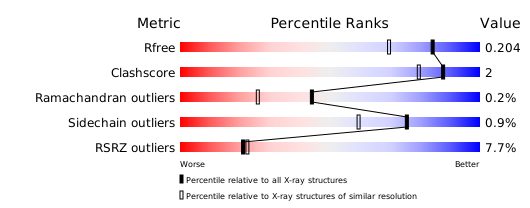
Structure validation
Download full validation report


