






 9CAP
9CAPSummary for 9CAP
| Entry DOI | 10.2210/pdb9cap/pdb |
| EMDB information | 45276 45399 |
| Descriptor | Bridge-like lipid transfer protein family member 1 C-terminal domain-containing protein, Defect at low temperature protein 1, Vesicle transport protein, ... (5 entities in total) |
| Functional Keywords | native, membrane protein complex, bltp, lipid transport |
| Biological source | Caenorhabditis elegans More |
| Total number of polymer chains | 3 |
| Total formula weight | 547487.77 |
| Authors | Clark, S.A.,Vanni, S.,Kang, Y. (deposition date: 2024-06-17, release date: 2025-04-23, Last modification date: 2025-12-10) |
| Primary citation | Kang, Y.,Lehmann, K.S.,Long, H.,Jefferson, A.,Purice, M.,Freeman, M.,Clark, S. Structural basis of lipid transfer by a bridge-like lipid-transfer protein. Nature, 642:242-249, 2025 Cited by PubMed Abstract: Bridge-like lipid-transport proteins (BLTPs) are an evolutionarily conserved family of proteins that localize to membrane-contact sites and are thought to mediate the bulk transfer of lipids from a donor membrane, typically the endoplasmic reticulum, to an acceptor membrane, such as that of the cell or an organelle. Although BLTPs are fundamentally important for a wide array of cellular functions, their architecture, composition and lipid-transfer mechanisms remain poorly characterized. Here we present the subunit composition and the cryogenic electron microscopy structure of the native LPD-3 BLTP complex isolated from transgenic Caenorhabditis elegans. LPD-3 folds into an elongated, rod-shaped tunnel of which the interior is filled with ordered lipid molecules that are coordinated by a track of ionizable residues that line one side of the tunnel. LPD-3 forms a complex with two previously uncharacterized proteins, one of which we have named Spigot and the other of which remains unnamed. Spigot interacts with the N-terminal end of LPD-3 where lipids are expected to enter the tunnel, and experiments in multiple model systems indicate that Spigot has a conserved role in BLTP function. Our LPD-3 complex structural data reveal protein-lipid interactions that suggest a model for how the native LPD-3 complex mediates bulk lipid transport and provides a foundation for mechanistic studies of BLTPs. PubMed: 40269155DOI: 10.1038/s41586-025-08918-y PDB entries with the same primary citation |
| Experimental method | ELECTRON MICROSCOPY (2.7 Å) |
Structure validation
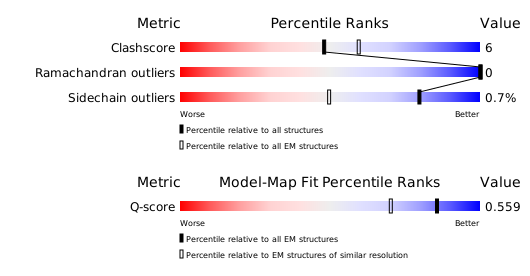
Download full validation report


