






 9C91
9C91
Assimilatory NADPH-dependent sulfite reductase minimal dimer
Summary for 9C91
| Entry DOI | 10.2210/pdb9c91/pdb |
| EMDB information | 45359 |
| Descriptor | Sulfite reductase [NADPH] flavoprotein alpha-component, Sulfite reductase [NADPH] hemoprotein beta-component, FLAVIN-ADENINE DINUCLEOTIDE, ... (8 entities in total) |
| Functional Keywords | sulfite reductase; hemoflavoprotein; oxidoreductase; cryo-em, flavoprotein |
| Biological source | Escherichia coli More |
| Total number of polymer chains | 2 |
| Total formula weight | 130829.05 |
| Authors | Ghazi Esfahani, B.,Walia, N.,Neselu, K.,Aragon, M.,Askenasy, I.,Wei, A.,Mendez, J.H.,Stroupe, M.E. (deposition date: 2024-06-13, release date: 2025-02-12, Last modification date: 2026-08-12) |
| Primary citation | Ghazi Esfahani, B.,Walia, N.,Neselu, K.,Garg, Y.,Aragon, M.,Askenasy, I.,Wei, H.A.,Mendez, J.H.,Stroupe, M.E. Structure of dimerized assimilatory NADPH-dependent sulfite reductase reveals the minimal interface for diflavin reductase binding. Nat Commun, 16:2955-2955, 2025 Cited by PubMed Abstract: Escherichia coli NADPH-dependent assimilatory sulfite reductase (SiR) reduces sulfite by six electrons to make sulfide for incorporation into sulfur-containing biomolecules. SiR has two subunits: an NADPH, FMN, and FAD-binding diflavin flavoprotein and a siroheme/FeS cluster-containing hemoprotein. The molecular interactions that govern subunit binding have been unknown since the discovery of SiR over 50 years ago because SiR is flexible, thus has been intransigent for traditional high-resolution structural analysis. We use a combination of the chameleon® plunging system with a fluorinated lipid to overcome the challenges of preserving a flexible molecule to determine a 2.78 Å-resolution cryo-EM structure of a minimal heterodimer complex. Chameleon®, combined with the fluorinated lipid, overcomes persistent denaturation at the air-water interface. Using a previously characterized minimal heterodimer reduces the heterogeneity of a structurally heterogeneous complex to a level that we analyze using multi-conformer cryo-EM image analysis algorithms. Here, we report the near-atomic resolution structure of the flavoprotein/hemoprotein complex, revealing how they interact in a minimal interface. Further, we determine the structural elements that discriminate between pairing a hemoprotein with a diflavin reductase, as in the E. coli homolog, or a ferredoxin partner, as in maize (Zea mays). PubMed: 40140349DOI: 10.1038/s41467-025-58037-5 PDB entries with the same primary citation |
| Experimental method | ELECTRON MICROSCOPY (2.78 Å) |
Structure validation
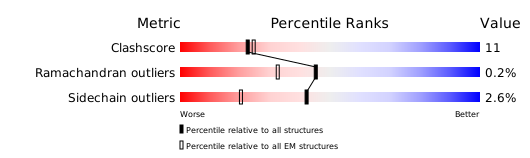
Download full validation report


